

The importance of peer review in scientific publishing cannot be overstated. At AIP Publishing, we believe robust peer review serves as a bridge to stronger, more impactful research, and is essential to the advancement of science and upholding research integrity. This guide explains what happens after you submit, how peer review improves your manuscript, and how to turn reviewer feedback into a better paper.
Peer review that works for you
When we say peer review supports the advancement of science, what does that really mean for you? AIP Publishing’s process includes:
- Bringing brilliant minds together to drive science forward: Your manuscript is matched with qualified reviewers who understand your field and can offer fair, constructive, high-quality feedback. Editors and supporting technology keep the peer review process moving.
- Feedback that strengthens and validates your work: Authors submitting to AIPP’s journals consistently report that peer review helps clarify their arguments, improve methods and presentation, strengthen conclusions, and enhances impact while connecting them with the wider research community.
- Safeguarding research integrity: Transparent policies, conflict-of-interest disclosures, and confidentiality standards ensure that robust, reproducible work enters the scientific record.
- Cover letter: Some journals require a cover letter to explain your manuscript’s significance and help editors decide whether to move the manuscript forward into peer review.
Inside the black box: What happens after you submit your manuscript?

Peer review isn’t just a check point on the way to publication. Every step in the process is carefully designed and integral to making your paper stronger, clearer, and more impactful. Here’s what happens when your paper arrives at AIP Publishing:
- Integrity from the start: With integrated plagiarism detection, we ensure your work is original, properly credited, and meets ethical and quality standards.
- Editorial support: A dedicated editorial team ensures your manuscript is ready for review by checking it against the journal’s specific formats. This allows reviewers to concentrate on what matters most, the content of your paper.
- We secure expert, timely feedback: Our global peer review network and efficient systems ensure timely, high-quality feedback from the right reviewers for your manuscript. We tailor the review process for each journal using customized checklists and reviewer guidelines to provide feedback that is both highly relevant and delivered as fast as possible.
Peer Reviewers: The people behind the process
At AIPP, peer review isn’t just a process; it’s a partnership. When your manuscript passes our quality checks, it’s assigned to an editor who engages with it from start to finish. Here’s how we help ensure you derive the most value from the process:
- We invest in recruiting, training, and supporting editors who are renowned experts in their fields who guide our journals and serve our authors, so you and your research are always in good hands.
- Editors use advanced tools and our global AIPP peer review networks to recruit reviewers, ensuring a balanced, high-quality review process.
- Editors don’t just gather reviews: they read, engage, and integrate feedback with their own insights to make informed decisions. That means every paper is deeply considered, and you’re getting personalized, actionable feedback.
- While quality peer review takes time, our editors keep the process on track so your research is promptly and fairly assessed and refined into the best version it can be.
Interested in becoming an AIP Publishing peer reviewer? Here’s everything you need to know.
How to respond to peer review feedback effectively
Reviewers critically assess your manuscript for clarity, validity, and methodological soundness, and may also evaluate its originality and novelty. Their constructive feedback is intended to strengthen your work and maximize the impact of your research. Reviewers want to help your work resonate with both specialized and broader audiences and increase the chances of publication success. This constructive critique can be the difference between a manuscript that struggles to find a home and one that resonates widely.
Always approach reviewer comments thoughtfully. It’s perfectly acceptable to disagree with a peer review, but always provide a clear, well-reasoned justification and keep your response polite and professional. Remember, peer review is a collaborative process. Be open to compromise and seek clarification when needed; that’s how you turn feedback into impact.
After the peer review process is completed, the editor will confirm if your work is a good fit for the journal. If they see potential and invite a revision, you’ll need to resubmit your work along with a response letter explaining how you addressed the reviewers’ comments. In many cases, reviewers are asked to re-evaluate the revised work to support its further development. If your manuscript is not accepted, you’ll need to consider whether to incorporate the feedback before submitting elsewhere.
Find out more about how we support peer review at AIPP
Set yourself up for a smooth review: How to prepare a manuscript for submission
As you prepare your manuscript for submission, use our author Instructions and journal specific formats to ensure it meets the requirements for your chosen journal to avoid delays or desk rejection.
- Clarity: Be sure to write in scientific American English with the conclusion in non-technical language.
- Templates and formats: Proper formatting reduces reviewer friction and prevents technical delays. Be sure to follow the specific formatting requirements for the journal of your choice.
- Scope and length: Ensure your manuscript fits the journal’s scope and word limits to avoid desk rejection.
- Methods and reproducibility: Reviewers must be able to interpret your findings, so ensure all supplementary files and figures are clear and accurate. Where relevant, share your code or data (required for some journals).
- Ethics and author declarations: It’s essential you include a conflict-of-interest statement (even “none”), ethics approval for human or animal research, and an author contributions summary (CRediT).
Beyond acceptance: The critical role of research curation and discoverability
Our support doesn’t end when your manuscript is accepted for publication. We protect and promote your research so it can be discovered and appropriately credited.
We manage every aspect of the research’s presentation and impact, from metadata and stable URLs to licensing. This ensures your research is discoverable, accurate, and properly attributed. We also make sure your published article is correctly indexed in major databases, helping others find and cite it. Our dedicated marketing team promotes your research to maximize visibility and reach.
See some of our latest journal content: In the news
Peer review is essential to strengthening your manuscript and confirming the highest standards of research integrity are followed. At AIP Publishing, the peer review process is designed to support you from submission to publication by connecting your work with qualified experts who provide constructive feedback. With transparent policies, ethical safeguards, and a global network of reviewers, our peer review process is a collaborative partnership designed to improve your manuscript’s clarity, rigor, and discoverability.
Ready to submit? Start your journey by finding the right journal.
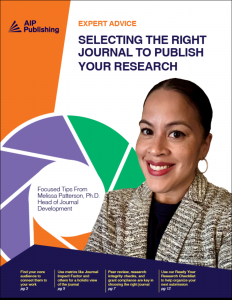 Get Your Free Guide! Download “Expert Advice: Selecting the Right Journal to Publish Your Research” featuring Melissa Patterson, Ph.D., Head of Journal Development, for insider tips to help you with your next submission.