

Too much thyme can be irritating, making it important to nanodose.
From the Journal: Physics of Fluids
WASHINGTON, Jan. 13, 2026 – With a myriad of health effects, thyme extract may seem like a magic medicinal ingredient. Its biologically active compounds — thymol, carvacrol, rosmarinic acid, and caffeic acid — provide anti-inflammatory, antimicrobial, antioxidant, and immune benefits.
But thyme extract also has downsides. It vaporizes quickly (a waste of thyme!), making it challenging to use, and too much of it can be irritating, causing rashes and digestive issues.
A solution to both problems is to encapsulate nanodroplets of thyme extract within another fluid, allowing for small doses and avoiding evaporation. Researchers from Tomsk Polytechnic University and Surgut State University, in Russia, developed a method to achieve encapsulated nanodoses of thyme, which they published in Physics of Fluids, by AIP Publishing.
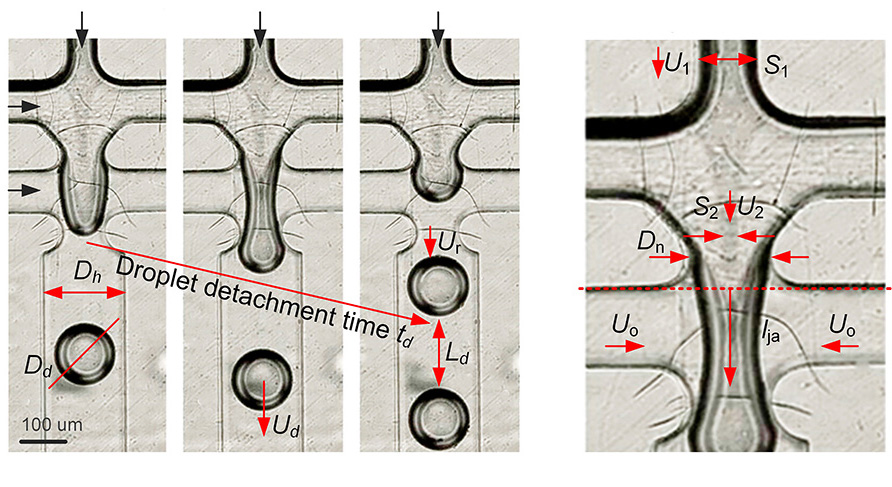
The researchers’ process involved jets of thyme extract, gelatin, sodium alginate — a commonly used thickening agent in the food industry — and oil. They first created a solution of thyme extract and gelatin and then pushed this through a tiny chip simultaneously with a jet of sodium alginate. The chip focused the two fluids into a single flow, but with a clear boundary between the components. Next, a jet of oil sent in the perpendicular direction broke the multicomponent fluid apart into tiny, encapsulated droplets.
The key takeaway from this work isn’t the dose of the thyme itself, but the demonstration that accurate thyme extract nanodosing is possible. Additional work is needed to take the nanodose and place it into an oral capsule for pharmaceutical uses.
“The system tends to be self-regulating in order to deliver a relatively consistent dose, which is valuable for drug delivery,” said author Maxim Piskunov. “At the same time, changing and adjusting the diameter of the microdroplets containing a biologically active substance nanodose is only possible by varying the oil phase flow rate.”
The technique is not limited to thyme and can be extended even beyond the pharmacological industry into the food industry. Piskunov said incorporating machine vision and artificial intelligence can further help with real-time nanodosing analysis.
“We believe that this method can be used to encapsulate various aqueous extracts,” said Piskunov. “From our study, no significant limitations have been identified. Moreover, we are currently working on encapsulating a water-alcohol extract with a much higher concentration of biologically active substances.”
###
Article Title
Mathematical model of nanodosing of water-thyme extract using droplet microfluidics
Authors
Maxim Piskunov, Alexandra Piskunova, Alexander Ashikhmin, Sofia Kuimova, Yuliya Petrova, and Elena Bulatova
Author Affiliations
Tomsk Polytechnic University, Surgut State University