
Tribute to George Sheldrick, Whose Work Facilitated the Advance of Structural Crystallography into a Broadly Accessible Scientific Tool
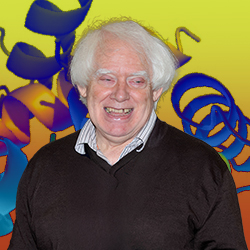 This special issue of Structural Dynamics is a tribute to the late Professor George M. Sheldrick, a monumental figure in the development of single-crystal diffraction analysis. George Sheldrick’s contributions to structural science have wielded an enormous influence in the manner in which a large part of that science is conducted, reported and interpreted. Structure analyses by single-crystal diffraction have grown in number and sophistication since the middle of the Twentieth Century, and especially so in roughly the last 50 years — in parallel with advances in instrumentation and in data processing. In this special issue we hope to craft a portrait of this line of structural science as it is today, together with a picture of how it got to this point and some credible thoughts on where it might be going. Beginning with the program Shelx76, which both solved and refined structures, structural scientists have had available in one, or in a small number of programs, a comprehensive set of tools for performing structure analyses using x-ray or neutron diffraction data. Subsequent programs in the same family added more functionality for structure solution and refinement. As instrumentation became more sophisticated and computing capacity grew, the structural science community found that the Shelx programs could be used with a similar look and feel as the original Shelx76, with ever more complex structures, including macromolecules, and with more copious data. This special issue of Structural Dynamics will include original research, perspectives and reviews related to the use of the Shelx programs, along with other studies not necessarily involving Shelx but influenced by Shelx or by programs with parallel or augmented functionality. It is hoped that a well-rounded picture of this sector of structural science will form a good backdrop for displaying George Sheldrick’s prodigious contribution to its development.
Topics covered include, but are not limited to:
- Structure analysis in modern chemistry
- Crystallographic programming
- Constraints and restraints in small-molecule crystallography
- Constraints and restraints in macromolecular crystallography
- The pipeline from crystal structure analysis to data base curation
- The development of structure validation for modern crystallography
- Data base studies using the results of structure analyses
- Possible future developments in structure refinement
- Solvent masking in structure refinement
- Structure determination by neutron diffraction
- Structural dynamics using neutron diffraction
- Structure and dynamics of materials at extreme conditions
- Charge and magnetic density in crystalline solids
- Absolute structure determination in small-molecule crystallography
- Atomic scattering factors, past and future
- The use of Shelx programs in teaching crystallography
- Outreach in structural science
Guest Editors:
Larry R. Falvello, University of Zaragoza