

From emptying jars to drying dishes, a study about thin film flows in the kitchen highlights everyday connections to physics.
From the Journal: Physics of Fluids
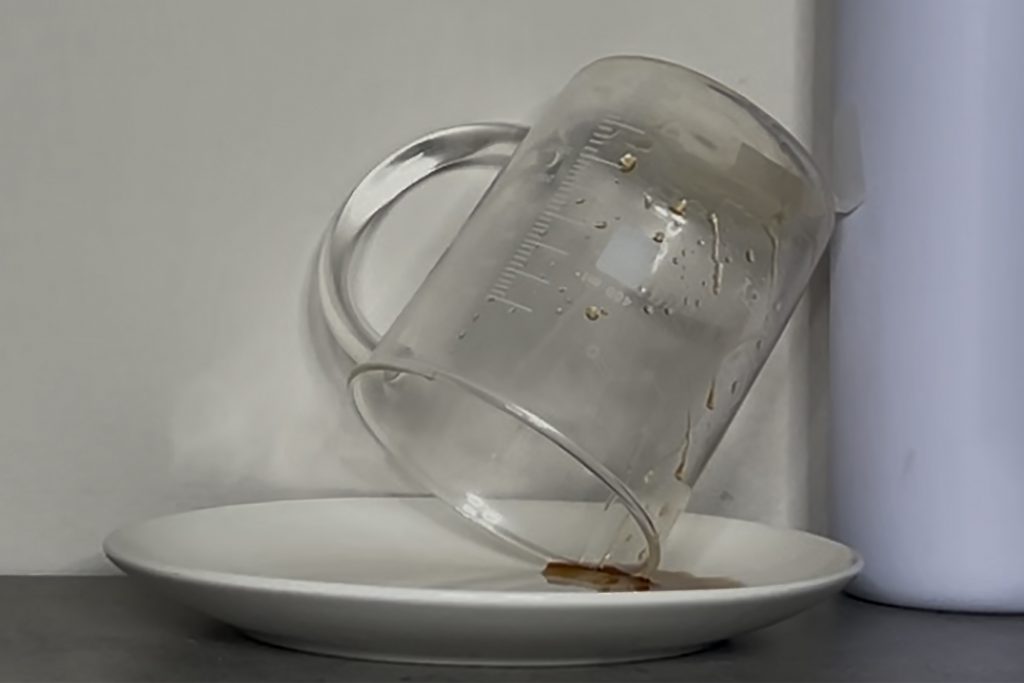
WASHINGTON, March 3, 2026 — When you reach the bottom of a container of milk or honey, you might be tempted to tip the container over to get that last pesky little bit out. After all, you only need another teaspoon for that recipe, and you’re sure it’s in there!
In Physics of Fluids, by AIP Publishing, researchers from Brown University present two related studies about thin film fluid flows in the kitchen: one about the relationship between how long it takes to tip the remaining liquid out of a container and its viscosity, and the other about the ideal time to wait before dumping water out of a wok to minimize rusting — it’s more effective to wait a few minutes to let the water accumulate so there’s more to pour out.
“The kitchen is sort of the prime laboratory,” said author Jay Tang. “It deals with a lot of chemistry, materials science, and physics.”
Most people have an intuitive sense of what viscosity is, often described as how thick a fluid feels. It is measured scientifically by applying a certain amount of force to a fluid and measuring its flow rate.
“If you want to empty a jar of water — a few brief seconds, and you have very little left. But if you try to empty a jar of honey, you need to wait longer,” said author Thomas Dutta. “How much longer? The viscosity can tell us.”
By measuring various examples, the researchers derived an exact equation for this flow. A particularly sustainable person can use this to decide how long to wait to collect 99% of what remains in their jar — but for most people, the intuitive understanding that something viscous, like honey or syrup, takes longer than water does will suffice.
“This tipping thing used to happen in my home when I was a kid,” said Dutta. “My grandma would do it with oil bottles or condensed milk.”
The same principle applies to drying out a wok. After washing and dumping out the initial water, Dutta and Tang calculated the ideal amount of time one should allow the remaining water to reaccumulate at its bottom before dumping it again — too long, and it will rust, but too short, and not enough of the water will pool. Figuring out just the right amount of time relies, unsurprisingly, on the viscosity of water. The answer: a few minutes.
“We use these common household examples to really try to show people in a quantitative way that these are all thin film fluid flow, and we can use fluid mechanics to calculate and predict and reliably estimate things,” said Tang. “The things people handle on a daily basis have a lot of physics behind them.”
###
Article Title
Authors
Thomas T. Dutta and Jay X. Tang
Author Affiliations
Brown University