

How certain proteins bind to materials and lead to ice growth at higher-than-normal temperatures.
From the Journal: Biointerphases
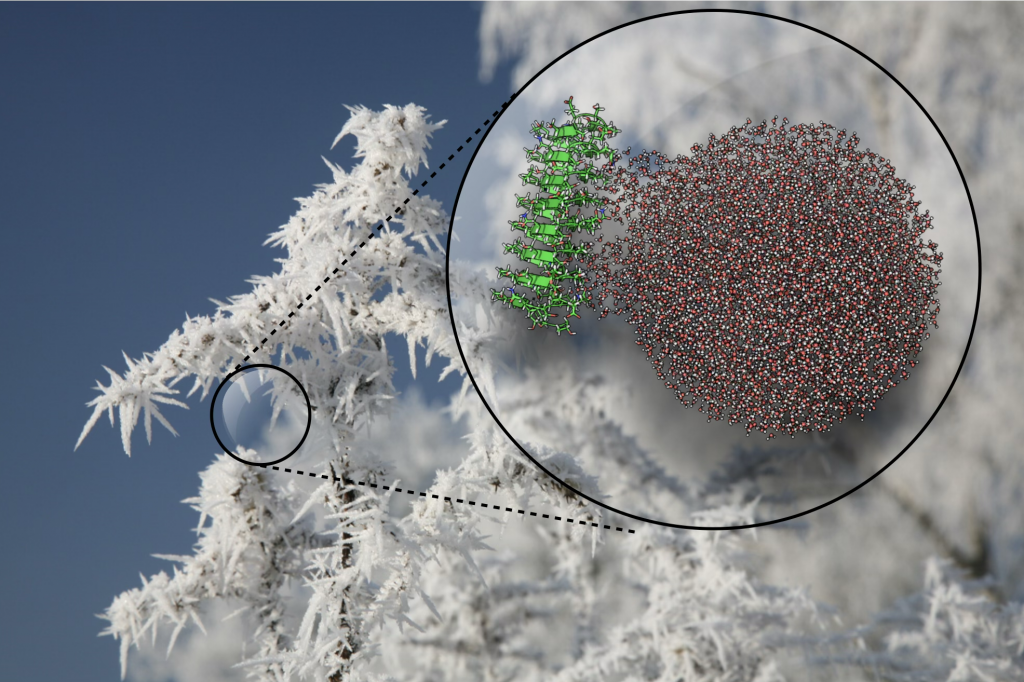
WASHINGTON, May 19, 2026 — Bacteria from the Middle East have caused precipitation all the way out in California. The same bacteria, which are known to attack plants, have also been found embedded within lumps of hail in West Africa.
Called Pseudomonas syringae, these bacteria contain ice-nucleating proteins (INPs), molecules that lead to ice formation. These INPs are the most potent known initiators of ice growth, but only naturally bind to organic surfaces. Understanding how they manipulate water into beginning the ice formation process at higher temperatures than normal — and whether they can also do it on human-made materials — can help scientists with applications like deicing, creating artificial snow, cryo-medicine, and more.
In Biointerphases, an AVS journal published by AIP Publishing, researchers from Aarhus University, in Denmark, and Oregon State University studied whether these proteins can bind to artificial surfaces in the same structured way as they do to cell membranes.
They found the proteins connect to a surface in a layer of single molecules with their ice formation side facing out, allowing ice to grow atop the surface. Importantly, the proteins do not seem to care what type of material they are binding to; for both artificial and natural surfaces, the INPs bind in remarkably similar ways, at similar thicknesses, in similar arrangements, and with similar levels of coverage.
“Normally, these proteins bind to cell surfaces, and I was expecting that it would be a bit more picky about the surface chemistry,” said author Tobias Weidner. “Oftentimes, when you put proteins on surfaces — especially artificial surfaces — they fall apart and lose their function.”
The fact that INPs bind so readily to artificial surfaces is huge. Typically, forcing proteins onto artificial surfaces requires tricky bioengineering to create new chemistries that mimic natural environments. INPs’ willingness to latch onto surfaces in an ordered way provides a shortcut, allowing them to continue to grow and potentially be used as is.
“We can sort of fast-forward this and put it straight on the surface,” Weidner said.
INPs are very long proteins, so the researchers used a truncated version in their studies, which are cheaper and easier to handle. They plan to explore whether a full-length INP can work even better than their shortened version on artificial surfaces, opening up further avenues for bioinspired freezing applications.
###
Article Title
Authors
Thaddeus Golbek, Mette H Rasmussen, Mikkel Bregnhøj, Thomas Boesen, Taner Drace, Ryan Faase, Joe E Baio, and Tobias Weidner
Author Affiliations
Aarhus University, Oregon State University
Biointerphases
Biointerphases, an AVS journal published by AIP Publishing, emphasizes quantitative characterization of biomaterials and biological interfaces. As an interdisciplinary journal, a strong foundation of chemistry, physics, biology, engineering, theory, and/or modelling is incorporated into original articles and reviews. See: https://pubs.aip.org/avs/bip.