

As Earth’s ice melts at an accelerated pace, it is important to understand how the wake of an ice structure affects the melt rate of its neighbors.
From the Journal: Physics of Fluids
WASHINGTON, May 5, 2026 — Earth’s ice is melting. As icebergs break away from glaciers and melt away, the fresh meltwater mixes into its saltwater surroundings.
However, icebergs do not exist in isolation. In Greenland, for example, jammed collections of icebergs and sea ice make up what are known as mélanges. Determining how these pieces of ice are affected by the meltwater of their neighbors is key to understanding — and eventually reducing — global ice loss.
In Physics of Fluids, by AIP Publishing, Kari Perry and Sarah Morris, from Montana State University, used pairs of ice cylinders to study how the meltwater from one ice structure alters the melting of another.
“Meltwater from icebergs can do things like transport fresh water to other areas of the ocean; it can redistribute heat, salt, and nutrients,” said Morris. “We need to know how these things are moving so we can predict ecosystem changes.”
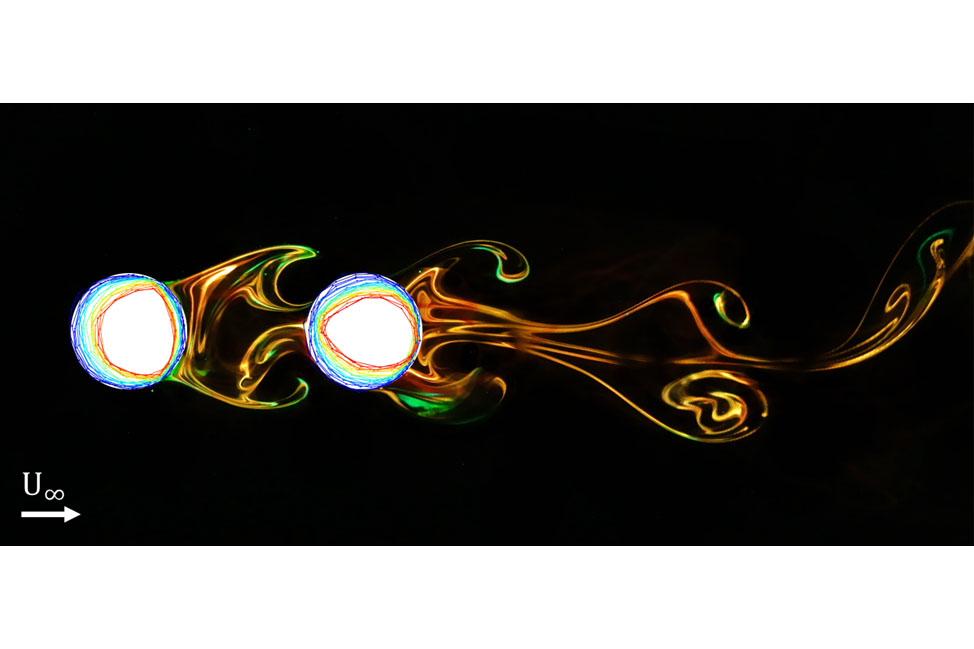
Using the Montana State University towing tank facility, Perry conducted a series of experiments in which she towed two pieces of cylindrical ice through a tank of water, with the two pieces melting as they traveled. She systematically changed the gap between them to understand its effects and used a combination of imaging techniques to measure how the shapes and melt rates of the ice cylinders changed over time.
Though the upstream cylinder largely behaved the same as it would on its own, the distance between the two determined the final shape that the downstream piece of ice ultimately took.
“If they’re really close together, the front face of the downstream cylinder is going to be protected from the warmer incoming flow,” said Morris. “The final shape that it is going to take has a very different aspect ratio than if it were by itself.”
At short distances, cold meltwater from the upstream cylinder’s wake becomes “trapped” between it and its neighbor, acting as insulation for the downstream cylinder. As this distance grows, the downstream cylinder experiences less protection until eventually the two can no longer feel the effects of each other.
Though coupled wakes behind solid cylinders are already well understood, the feedback loop between the ice and its surrounding water makes this process complex; the shapes of the ice pieces affect the flow, but the flow affects the shapes of the ice pieces. These effects will be even more evident when researchers expand their findings to larger scales.
“This becomes really important when we start talking about things like mélanges, where you have lots of ice bodies in proximity that are inherently going to affect each other’s melt rates,” said Morris.
###
Article Title
Near-field flow interactions govern local ice melting dynamics
Authors
Kari E. Perry and Sarah E. Morris
Author Affiliations
Montana State University