
3D Smart Oxide Nanomaterials for Future Advanced Technologies
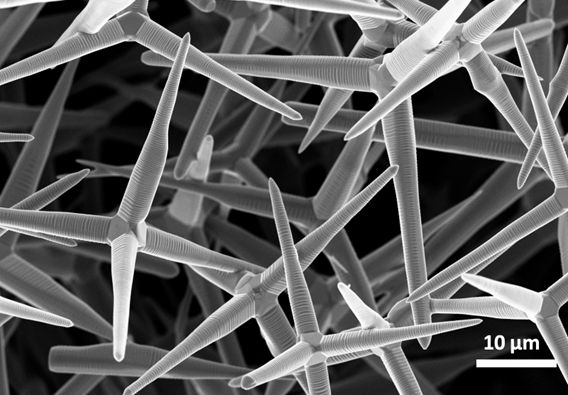 Nanoscale structures exhibit exceptional physical, chemical, catalytic, and mechanical properties due to their high surface contributions at nanoscopic dimensions. Various methods have enabled their growth and partial understanding of structure–property relationships. Yet, their integration into everyday technologies remains limited, as handling, accessibility, and cost-effectiveness pose major challenges. Oxide nanostructures with complex shapes—tetrapods, multipods, flowers, sea urchins—offer a solution through their self-assembling ability. Regardless of placement, these building blocks form three-dimensional porous, interconnected networks. Such architectures provide easy surface accessibility, structural stability, and simple utilization. Additional nanostructures can also be integrated to impart desired functions. Hybrid 3D oxide materials thus open new opportunities to study structure–property relationships and enable advanced applications in mechanics, photonics, plasmonics, nanoelectronics, sensing, and more. This special issue will focus on (i) Info development of new 3D nanomaterials, (ii) understanding their structure–property relationships, and (iii) various applications.
The exploration of surfaces, interfaces, nanostructures and thin films using:
- Nanotechnology
- Nanowires
- 3D Nanomaterials
- Porous Materials
- Fabrication
- Structure-property Relationship
- Applications
Guest Editors
Prof. Yogendra Kumar Mishra, University of Southern Denmark
Prof. Yanqiu Zhu, University of Exeter, UK
Prof. Richard Fu, Northumbria University, New Castle, UK
Submission Instructions:
Articles published in Nanotechnology and Precision Engineering are freely accessible without any publication charge. The open access publication fee is funded by Tianjin University. Users are free to share and adapt the material in any format, provided appropriate credit is given.