
Mechanobiology and Bioactive Interfaces
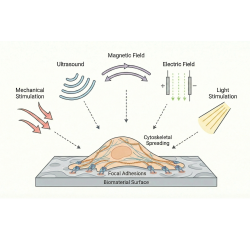 Biological systems are highly responsive to surface chemistry, topography, stiffness, dynamic mechanical stimuli, and bioactive molecular factors introduced through surface engineering strategies. These interfacial parameters operate in a coordinated manner to influence protein adsorption, cell adhesion, differentiation, immune modulation, and tissue organization. A mechanistic understanding of these coupled physicochemical and biological interactions is essential for the rational design of advanced biomaterials and biomedical devices. This collection examines how interfacial structure, chemistry, mechanical properties, and functional surface modifications collectively regulate biological responses across molecular, cellular, and tissue scales. Fundamental and application-oriented studies provide quantitative and mechanistic insight into interface-mediated biological regulation, including diverse approaches to bioactive surface modification and functionalization.
Topics covered include, but are not limited to:
- Mechanobiological regulation at biointerfaces
- Bioactive surface modification and functionalization
- Interface-driven cell behavior, adhesion, and differentiation
- Coupling of surface chemistry, morphology, and mechanical properties
- Protein and biomolecule interactions at mechanically active interfaces
- Quantitative characterization of biointerfaces under mechanical stimuli
- Molecular dynamics and multiscale modeling of biointerfaces
- Bioactive and mechanosensitive biomaterials for biomedical applications
- Interface engineering for tissue engineering and regenerative medicine
- Review articles on the above topics
Editor
Il Won Suh, Jeonbuk National University, South Korea
Se Rim Jang, Harvard Medical School, USA