

Peer review integrity is the backbone of scientific publishing, and it works best when it’s free from bias. A new study by AIP Publishing offers some of the most comprehensive and current data about the common practice of allowing authors to suggest their own reviewers and if this practice contributes to a manuscript’s acceptance.
Key findings
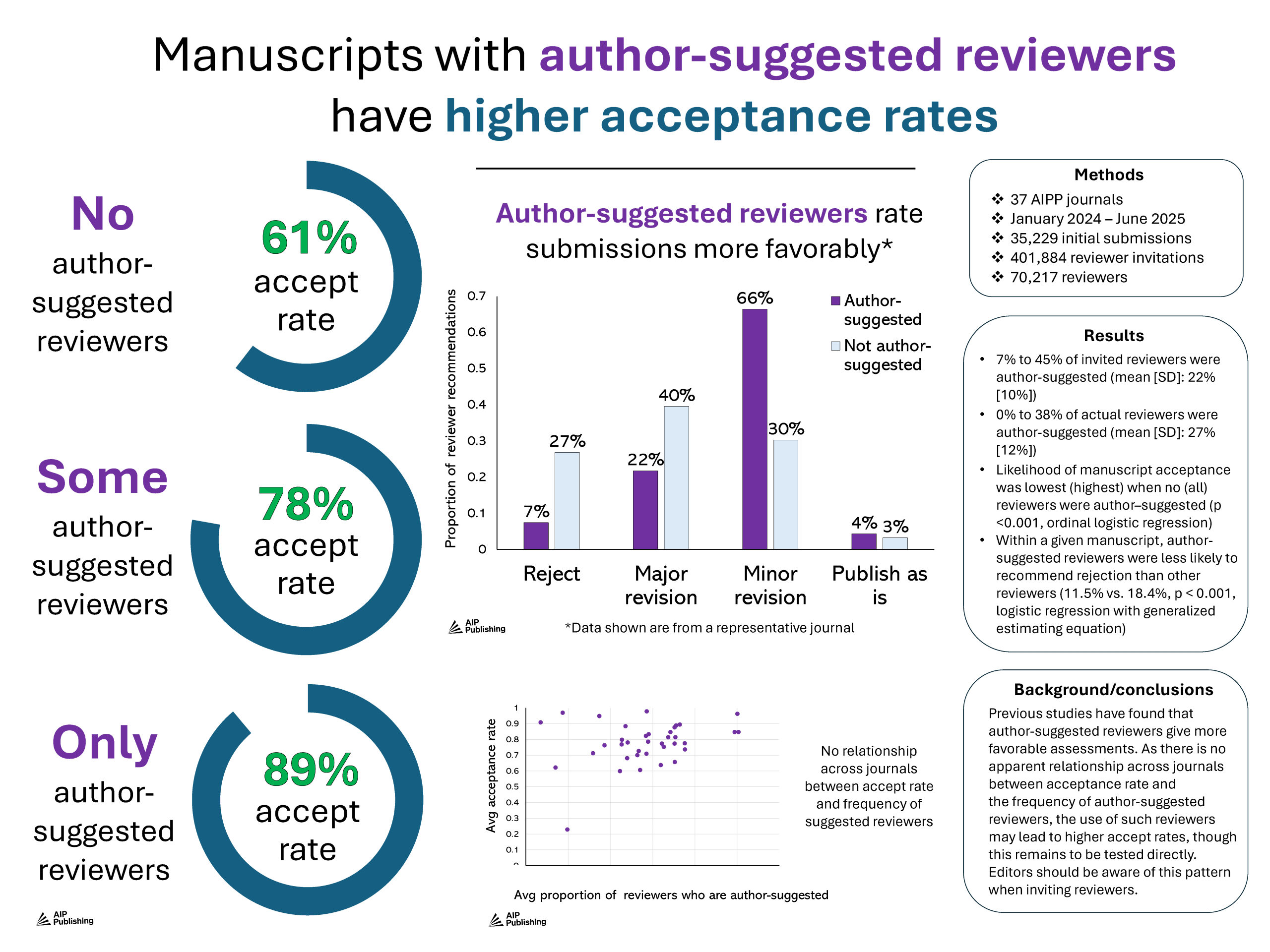
Analysis of over 35,000 manuscript submissions across 37 AIP Publishing journals between January 2024 and June 2025, covering over 400,000 reviewer invitations and more than 70,000 individual reviewers, found that papers reviewed exclusively by author-suggested reviewers had significantly higher acceptance rates than papers reviewed only by editor-selected reviewers.
Conclusion: While author-suggested reviewers provide valuable expertise, editors should balance reviewer selection with non-suggested reviewers to promote unbiased peer review.
What does using Author-Suggested Reviewers mean for authors?
What is an Author-Suggested Reviewer (ASR)? An ASR is an expert recommended by a manuscript author during the submission process who may be invited by the journal editor to participate in the peer review process.
- Our data shows there is a striking difference in publication outcomes based on reviewer composition.
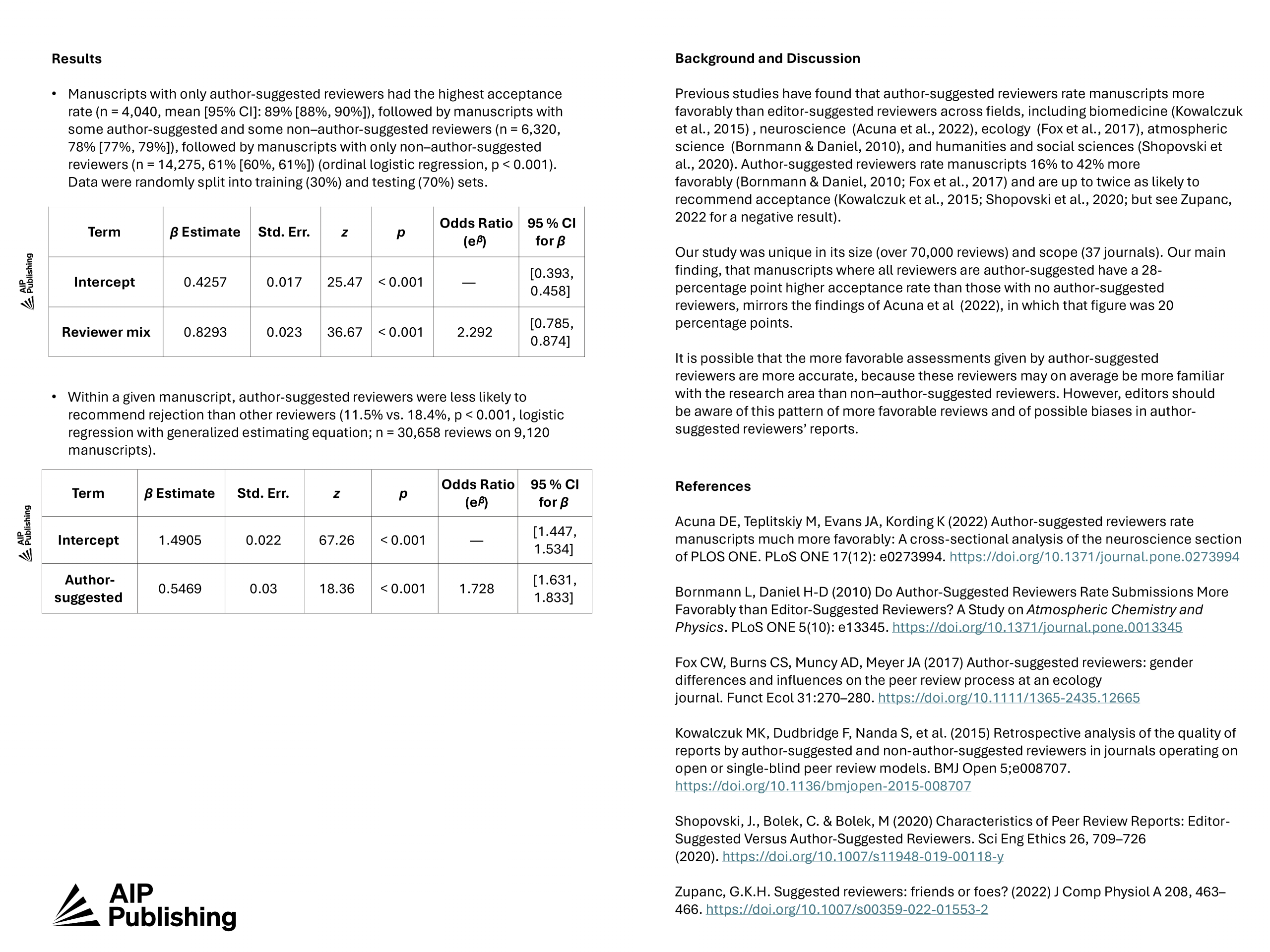
- Manuscripts evaluated exclusively by ASRs had an 89% acceptance rate, compared to 78% for a mix of ASR and editor-suggested reviewers, and 61% for manuscripts with no ASRs.
- When looking at individual recommendations within a given manuscript, ASRs provided more favorable reviews, for example, recommending rejection at a lower rate than editor-selected reviewers (12% vs.18%).
We found no relationship in our data set across the 37 journals between their overall acceptance rates and the frequency with which they utilize ASRs. This suggests that while overall journal selectivity is governed by editorial policy, the individual choice to populate a specific paper’s panel with author-suggested reviewers can heavily influence its final outcome.
Key takeaway: This finding highlights a crucial balancing act. While using author-suggested reviewers provide highly responsive, specialized expertise, it also introduces a clear pattern of leniency.
Should authors suggest peer reviewers?
Recommending experts with relevant subject knowledge can help editors identify reviewers who understand your field and can evaluate your work fairly.
The data does not suggest that author-suggested reviewers should be eliminated from peer review. Rather, it highlights the value of combining author recommendations with editor-selected reviewers to balance subject matter expertise with editorial independence as is the practice at AIP Publishing.
Creating balance to maintain peer review integrity
A rigorous and balanced peer review process ultimately benefits authors. Independent, constructive feedback strengthens manuscript submissions, improves the quality of published research, and increases confidence in the findings among readers, reviewers, and future collaborators.
This data reinforces why ASR suggestions should always be based on expertise rather than personal or professional relationships. By recommending independent experts who can provide objective feedback, authors help strengthen the credibility of both their manuscript and the scientific record.
- Authors: Avoid suggesting reviewers including co-authors from papers within the past 5 years, colleagues, or those with whom you share a close professional relationship. Potential conflicts of interest are outlined in our publication ethics policy. Conflicts of interests can undermine the peer review process, even when the research itself is sound.
- Invited peer reviewers: Declare to the editor any actual or potential conflicts of interest you may have with the authors as outlined in our policy on reviewer responsibilities and ethics. This will ensure the process is fair to both you and the author and avoids any unintended reviewer bias.
Explore the evidence behind the findings
For a visual breakdown of these statistical regression models and journal-level analyses, we invite you to explore the poster below. It offers essential guidance for editors seeking to balance administrative efficiency with peer review.
This research was conducted by AIP Publishing experts, Biz Turnell, Senior Research Integrity and Ethics Specialist, Melissa Patterson, Head of Journal Development, and Matthew Barr, Senior Data Scientist and presented by Biz at the 9th World Conference on Research Integrity (WCRI 2026) in Vancouver, Canada.
More resources about peer review and research integrity at AIP Publishing
- In Conversation with AIPP’s Research Integrity and Publication Ethics Team
- How Peer Review Works at AIPP
- How to Become a Peer Reviewer
Meet the author: Biz Turnell
 Biz Turnell is a Senior Research Integrity and Ethics Specialist at AIP Publishing. Prior to joining AIPP in 2025, they were an in-house editor at Springer Nature's Scientific Reports. They have a Ph.D. in Neurobiology and Behavior from Cornell University and completed a postdoctoral fellowship at the Technische Universität Dresden, in Germany. Biz enjoys running, hiking, and generally being active outside.