

The best offense is a good defense, especially when it comes to protecting your research. Building research integrity into your workflow helps you establish a reliable record of your methods and decisions. With practical checkpoints throughout the research process, you can confidently explain how you reached your conclusions and demonstrate the credibility of your findings. It’s a proactive way to protect both your research and your reputation.
What is research integrity, and why is it important?
Research integrity means conducting and communicating research with honesty, transparency and accountability. It helps researchers produce reliable findings, accurately recognize contributions, and maintain a trustworthy research record. Strong research integrity practices also make it easier to verify results, respond to peer review feedback and build confidence in your published work.
Research integrity from the start
Your research represents months or years of planning, investigation, and discovery. Protecting that work means more than preventing misconduct. It means creating a reliable record of what you did, why you did it, and how you reached your conclusions. Research integrity should begin when you’re designing your research plan and not when it’s time to submit your manuscript. The decisions you make at the start can strengthen the reliability of your findings and help others understand your work.
Taking simple steps can help you reproduce results, reduce potential disputes and recognize collaborators fairly. They can also prepare you to respond confidently to questions during peer review. By building a few integrity checkpoints into your existing workflow, you can protect the research behind your publication.
Document your research protocols and methodology
Good documentation does more than preserve research data. It captures the reasoning behind your methods and the decisions that shaped your study. Even when a research project is carefully planned, unexpected findings or practical constraints will require adjustments. Maintaining accurate documentation will help you explain those decisions without relying on memory.
Build these practices into your workflow:
- Document your protocols and methodology, including experimental procedures and analysis methods.
- Record and explain deviations from the original research plan, including exclusions or methodological changes.
- Maintain version histories for datasets, code and research protocols.
- Establish consistent file naming and storage practices across your research team.
An example in practice: If you modify an experimental procedure, record what changed and why. This provides context that may not be apparent from the final results.
Your takeaway: Maintain a clear decision trail throughout your project. Months later, you or another researcher should be able to understand what you did and why.
Make your research results traceable
How can researchers ensure their findings are accurate and reproducible?
Researchers can strengthen research reproducibility by preserving original data and documenting analysis methods. Maintaining clear connections between results and supporting evidence, the regular verification of calculations, figures, and source materials helps identify errors early. These practices make it easier to reproduce analyses and explain findings during peer review. While documentation explains how you conducted your research, research traceability connects your findings to the evidence supporting them. Can you trace a key conclusion in your manuscript back to the original data or experiment? Preserving that connection helps you verify findings and respond to questions during peer review. It also makes it easier to reproduce analyses or correct errors when necessary.
Strengthen traceability by:
- Preserving original data separately from processed datasets.
- Connecting analysis files, code and calculations to the relevant experiments.
- Documenting and justifying data exclusions, corrections or transformations.
- Maintaining source information for figures, images and tables.
- Checking that major claims are supported by the underlying evidence.
An example in practice: When preparing a figure, retain the source dataset and analysis used to generate it. If a reviewer questions the result, you can revisit the evidence rather than reconstructing your process.
Your takeaway: Before drafting conclusions, trace your most important findings through the analysis to their original source. This helps protect the connection between your scientific claims and the evidence.
Define research ownership, roles, and credit early
Research integrity in scientific publishing also depends on accurately recognizing the people who contribute to the work. In collaborative research, responsibilities can change as projects develop. Discussing expectations early helps reduce misunderstandings and makes it easier to assign credit fairly.
- Start by identifying who is responsible for data collection, analysis, and manuscript preparation. Revisit these responsibilities when new collaborators join or the scope of the research changes.
- The Contributor Roles Taxonomy (CRediT) provides a framework for documenting individual contributions. It can help clarify responsibilities and support transparent author contribution statements.
- Keep a shared contribution record throughout the project rather than trying to reconstruct everyone’s involvement when it’s time to submit.
Remember—documenting a contribution does not automatically establish authorship. Your team should follow the relevant journal’s authorship criteria.
Your takeaway: Ask if everyone on your research team can explain their responsibilities and expected contributions. Addressing uncertainty early can help prevent authorship disputes and strengthen accountability.
Verify your research before someone else has to
Verification shouldn’t begin when a manuscript is ready for submission. Regular checks throughout your project can help identify inconsistencies before they affect your conclusions. Building research verification practices into your workflow allows you to evaluate whether results are accurate and interpretations are supported by the evidence.
Consider these checkpoints:
- Recheck calculations, statistical outputs and figure labels
- Confirm that citations support the claims attributed to them
- Ask a collaborator to independently review important analyses when appropriate
- Check that your methods accurately describe the procedures performed
- Verify outputs generated or assisted by digital tools, including artificial intelligence
An example in practice: An incorrect citation or mislabeled figure may seem minor but can create uncertainty about the reliability of your work.
Your takeaway: Schedule verification checkpoints at key project milestones. Catching errors early protects your credibility and can reduce avoidable questions during peer review or after publication.
Be transparent about research limitations and uncertainty
 Strong research doesn’t require perfect results. It requires an accurate account of what the evidence supports. Transparency in scientific research helps readers understand the significance of your findings without drawing conclusions beyond the study’s scope.
- As you evaluate your results, document unexpected outcomes and findings that contradict your original expectations. Null results may also provide valuable information about the research question.
- Distinguish between what you observed and how you interpret those observations. Identify methodological limitations and acknowledge sources of uncertainty.
- Review your manuscript title, abstract and figures to ensure they accurately represent the findings.
In practice: Results obtained under specific experimental conditions may not apply more broadly. Explaining those boundaries helps readers understand where your conclusions are supported.
Your takeaway: Maintain a record of limitations as your research progresses. Being transparent about uncertainty helps others evaluate your work and can strengthen confidence in your conclusions.
 Do a research integrity check before submission
What should researchers check before submitting a manuscript? Before submitting a manuscript, researchers should complete a research integrity checklist to confirm their methods are accurately documented, findings are supported by evidence, and author contributions are properly recognized. They should also verify citations, figures, and required disclosures to ensure the manuscript faithfully represents the research conducted.
Verify authorship and contributions
- Confirm that your collaborator list is complete and accurate.
- Apply the relevant journal authorship criteria, using the ICMJE recommendations where applicable.
- Prepare an accurate CRediT author contribution statement.
Prioritize transparency and reproducibility
Share research data, software and code when possible and appropriate.
- Apply the FAIR1 data principles: Findable, Accessible, Interoperable and R Using them can help make research outputs easier to discover and reuse.
- Provide complete supplementary materials.
- Verify that figures and datasets accurately represent the original evidence.
- Use established, discipline-appropriate data repositories.
Maintain ethical research practices
- Include required conflict-of-interest and funding disclosures.
- Provide applicable ethics approval documentation for human or animal research.
- Use appropriate citation and paraphrasing practices.
- Confirm that research images accurately represent the data and that modifications are disclosed where required.
- Disclose AI use according to the journal’s policies.
Review publisher requirements
- Before submission, consult AIP Publishing’s policies and ethics resources for relevant requirements.
Your takeaway: A final integrity check is more than a submission requirement. It is an opportunity to confirm that the published manuscript faithfully represents the research record you’ve built.
Protect your research by making integrity part of the process
Protecting research integrity isn’t something you do only before clicking Submit. It comes from the everyday decisions that shape your work. Documenting your methods preserves important context and maintaining traceable evidence supports reliable conclusions. Clear contribution records protect collaborators, while verification and transparency help others evaluate your findings. Together, these practices will protect your work and create a stronger foundation for scientific publishing.
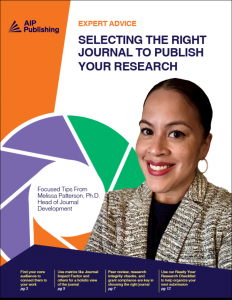 Get Your Free Guide! Download “Expert Advice: Selecting the Right Journal to Publish Your Research” featuring Melissa Patterson, Ph.D., Head of Journal Development, for insider tips to help you with your next submission.
1https://fairsharing.org/