

How to engineer a magnetically controlled robot with enough finesse to move around tiny clumps of cells
From the Journal: APL Bioengineering
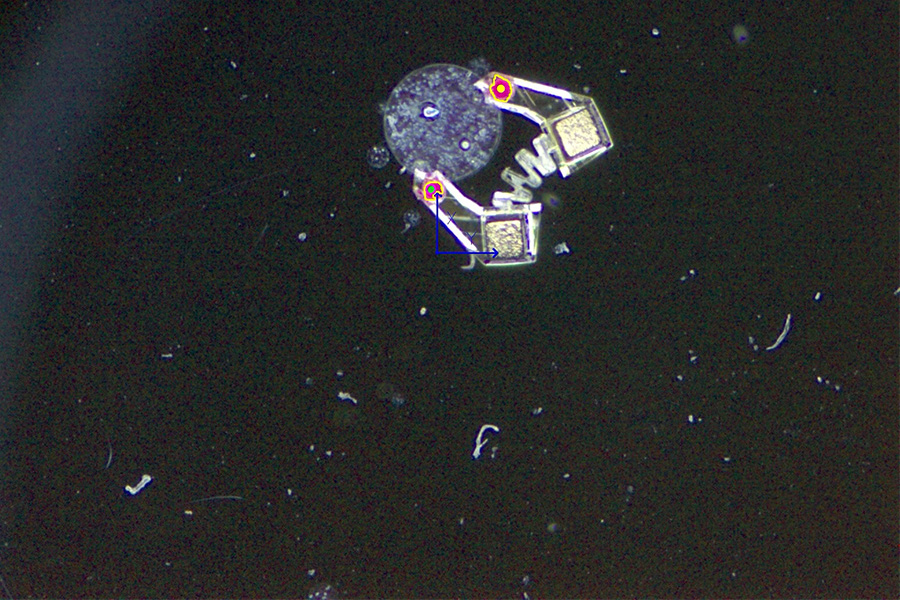
WASHINGTON, April 28, 2026 — In tissue engineering, the tiniest bit of improper force can harm a living culture. 3D clumps of cells — known as spheroids — can be used to model complex human tissues, because they can re-create specific cell-to-cell and cell-to-matrix interactions. But these spheroids are also fragile, and common techniques of moving them manually via suction can easily damage them.
In APL Bioengineering, by AIP Publishing, researchers from Purdue University designed a force-sensing miniature robot, called a mobile microgripper (MMG), to handle these cell spheroids with care.
“Other techniques for cell spheroid bioassembly can affect the tissue construct and/or apply limited manipulation forces,” said author David Cappelleri. “The force-sensing MMG presented here addresses these current issues by allowing the safe bioassembly of different spheroids into a single construct.”
Integrating different types of spheroids into one culture is key for tissue engineering, since, in real life, more than one cell type can grow in a tissue. But individual spheroids have to be grown in place and then moved around, introducing the chance of damage to the spheroid.
The MMG is a microscopic robot that resembles the gripping part of the claw toy. It is made of two arms connected by a hinge for a controlled — and gentle — gripping. Even better, it’s controlled by magnets, which are biocompatible with spheroids, decreasing the risk of collateral damage.
“This was a big part of the design — figuring out a way to use magnetic fields for both locomotion and for controlling the opening and closing of the gripper jaws,” Cappelleri said.
The gripping force is monitored and adjusted in real time, allowing researchers to adapt to the delicate nature of the cells. After simulating the efficacy of the MMG, in vitro testing showed that the device was able to successfully move and organize spheroids into neat patterns.
The researchers also verified that the range of gripping forces exerted by the MMG was compatible with the movement and subsequent survival of the spheroids.
Currently, the tiny robot can successfully assemble the spheroids in a cellular “sheet,” but in the future, the researchers want to use their tiny robots to create full engineered tissues. In addition, the researchers want to take their microgrippers a step further, transitioning from manual control to automated spheroid assembly.
###
Article Title
Force-sensing mobile microrobotic grippers for gentle and precise bioassembly of cell spheroids
Authors
Aaron C. Davis, Madison O’Brien, Iris Gong, Luis Solorio, and David J. Cappelleri
Author Affiliations
Purdue University