

More comfortable earplugs mean increased use and lower rates of hearing loss.
From the Journal: The Journal of the Acoustical Society of America
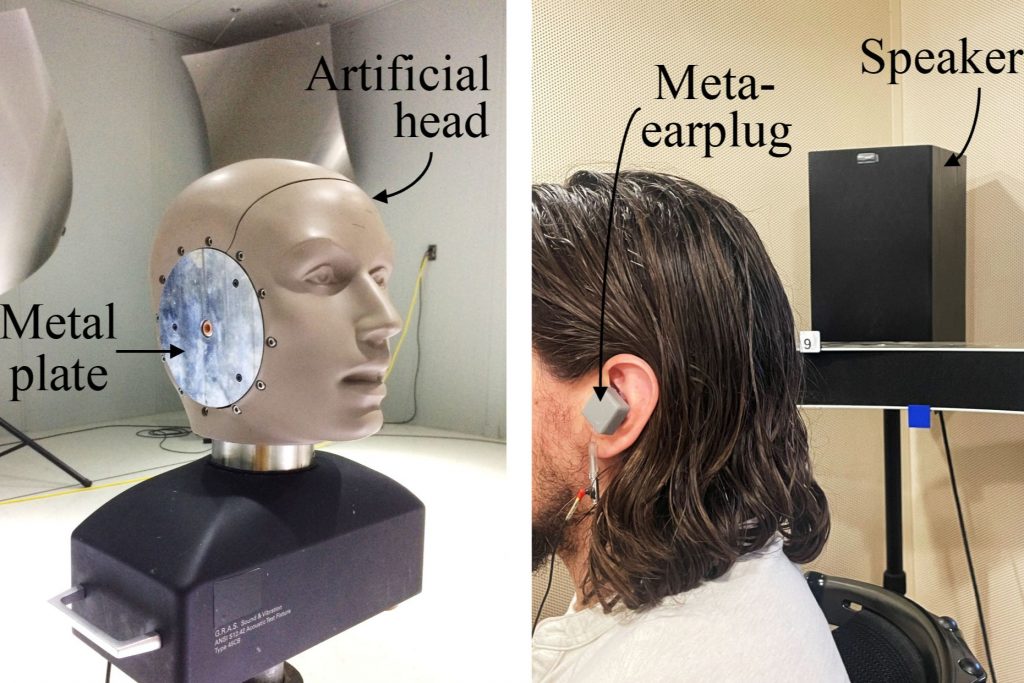
WASHINGTON, April 28, 2026 — Workplace hearing loss is one of the most common work-related illnesses. While hearing loss is preventable with earplugs, they can be uncomfortable, and users often remove them despite the risks. Low-frequency sounds, such as rumbling traffic and warehouse vibrations, are especially difficult to address because differences in ear physiology allow sound to leak into ears, despite protection from earplugs.
Traditional earplugs also make the user’s voice sound booming and hollow, known as the occlusion effect. It is caused by vocal vibrations that travel through bones and build up pressure on the eardrum when the ear canal is blocked with an earplug.
In the Journal of the Acoustical Society of America, published by AIP Publishing, researchers at the Institut de recherche Robert-Sauvé en santé et en sécurité du travail and the École de technologie supérieure in Québec, Canada, and the Institute of Acoustics at Le Mans University in France advanced the state of the art of “meta-earplugs” to address these problems.
“We found that comfort and protection, which are traditionally in tension in earplug design, can be improved simultaneously by the same technology — using meta-earplugs with Helmholtz resonators to precisely tune reflected sound waves in the ear canal,” author Kévin Carillo said.
Helmholtz resonators are bulb-shaped structures with narrow necks that soften the air pressure at the end of the earplug inserted into the ear and allow fine-tuning of the sound waves reflecting off surfaces in the ear canal.
“When an ear is sealed with an earplug, the space inside becomes a small, enclosed cavity where sound reflects back and forth between the eardrum and the earplug,” Carillo said. “These reflections interact with each other; depending on their timing, they can either add up, which increases pressure and reduces ear protection, or cancel each other out, which is the effect we want.”
The authors previously proved meta-earplugs are effective in reducing the occlusion effect. Building on their prior work, they optimized the meta-earplugs to protect against low-frequency rumbling sounds and vibrations that are common in industrial workplaces.
Low-frequency sounds cause pressure buildup in the ear when using conventional, passive earplugs. The authors designed an earplug with multiple resonators in a series, each tuned to a different frequency, which helps target a range of low-frequency sounds and relieves acoustic pressure. This allowed them to create an effective earplug for low-frequency sounds that doesn’t rely on electronics.
“The challenge at this tiny scale is precision: In the resonators, the cavities are a few cubic centimeters, and [their] necks are submillimeter,” Carillo said. “Achieving this accuracy required 3D printing, the most practical way to fabricate small, architecturally complex structures with the geometric precision needed for Helmholtz resonators to behave as designed.”
The researchers plan to continue advancing their work to apply to high-intensity sounds.
“Impulse noise includes short, sudden, high-intensity sounds such as nail guns, explosions, or other industrial impacts,” Carillo said. “These are particularly dangerous because the ear’s natural protective reflex does not react quickly enough to reduce the exposure.”
###
Article Title
Improving low-frequency attenuation of passive earplugs using Helmholtz resonators
Authors
Kévin Carillo, Franck Sgard, Olivier Dazel, and Olivier Doutres
Author Affiliations
Institut de recherche Robert-Sauvé en santé et en sécurité du travail, École de technologie supérieure, and Le Mans University