

To evacuate quickly in case of an emergency, elderly passengers, who may be limited in dexterity, should be evenly distributed among aircraft cabins.
From the Journal: AIP Advances
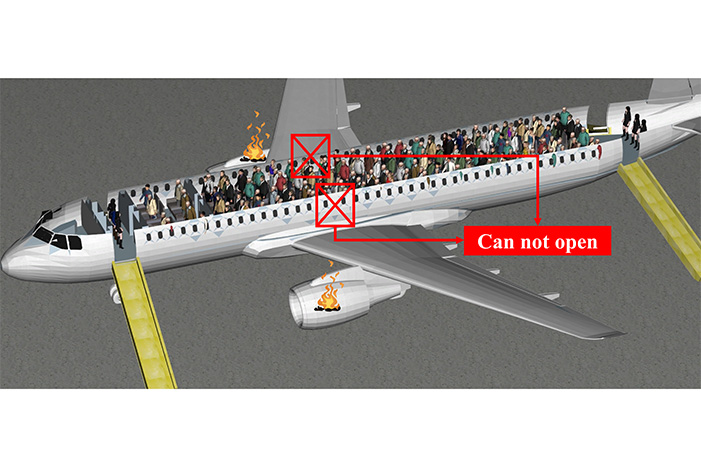
WASHINGTON, March 31, 2026 — In case of an emergency, the Federal Aviation Administration requires aircraft to be able to evacuate within 90 seconds. However, as the median age of the global population increases, the growing number of elderly airline passengers poses new challenges during emergency situations.
In AIP Advances, by AIP Publishing, an international collaboration of researchers simulated 27 different evacuation scenarios in case of a dual-engine fire in an Airbus A320, one of the most common narrow-body aircraft in the world. They compared three different cabin layouts with three different ratios of passengers over the age of 60 and three different distributions of those passengers.
“While a dual-engine fire scenario is statistically rare, it falls under the broader category of dual-engine failures and critical emergencies in aviation. History has shown that dual-engine failures and emergencies, such as the famous ‘Miracle on the Hudson’ involving Captain Sullenberger, can happen and lead to severe consequences,” said author Chenyang (Luca) Zhang. “Our study focuses on these low-probability but high-impact events to ensure the highest safety standards.”
In seeking the most efficient combination of factors, the researchers created full-scale computer-aided design models of the A320 cabin and used Pathfinder — the industry-standard software for evacuation modeling — to simulate passengers’ behavior. They found the proportion and location of elderly passengers have the largest effect on evacuation time.
The fastest option — a layout that accommodates a total of 152 passengers with two rows of first-class seats at the front, and 30 elderly passengers evenly distributed throughout the cabin — still required 141 seconds for all the passengers to reach the ground, much longer than the FAA mandates.
Previous studies have shown that cognitive decline in elderly populations can affect situational awareness and delay decision making, and that reduced dexterity can be exacerbated during high-stress situations. The researchers hope that incorporating this information into their findings — for example, by offering additional safety briefings to elderly passengers — will help further accelerate the deboarding process.
Children, infants, and pregnant women also introduce unique physical capabilities and behaviors that add another vital layer to evacuation modeling, which the group plans to investigate in their future work.
“We hope these findings help airlines proactively mitigate risks,” Zhang said. “By understanding how passenger distribution affects evacuation, airlines could potentially implement more strategic seating arrangements to optimize safety without compromising operational efficiency.”
###
Article Title
Authors
Xu Zhao, Ying Xia, Chenyang Zhang, Tianchang Meng, Gaobo Yang, Hua Chen, and Yu Zhang
Author Affiliations
University of Sydney, China Academy of Building Research, University of Calgary, Southwest Jiaotong University, West Air Co.