

Culturally inspired design can offer mechanical advantages while adding historical symbolism to materials.
From the Journal: Journal of Applied Physics
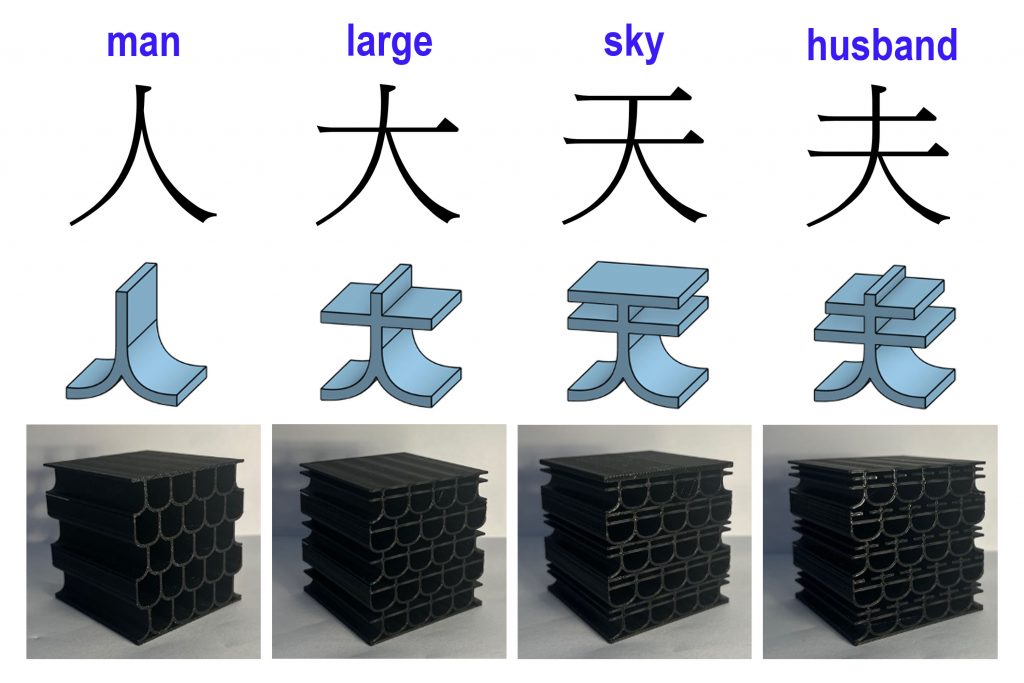
WASHINGTON, April 21, 2026 — From the geometric symmetry in Islamic tiles to the mechanical versatility of origami, cultural patterns have an extensive range of structures.
Inspired by cultural geometries, researchers from the University of Edinburgh created and tested metamaterials — materials whose properties depend highly on their patterned structure rather than solely composition — comprised of Chinese characters. They published their results in The Journal of Applied Physics, by AIP Publishing.
“Certain Chinese characters have strong, distinctive geometries, and these are shapes that ‘felt’ like they could exhibit unique mechanical properties and behaviors,” said author Parvez Alam.
The presence of curves, crossbeams, and gradation, and the fact that they fit into discrete square cells makes Chinese characters especially fit for creating functional, structural unit cells.
“These are architectural qualities that we see applied to metamaterials in general, and a question that came to mind was whether these ancient characters might also serve as unconventional metamaterial architectures with specialized properties and behaviors,” Alam said.
The authors tested the utility of materials made up of four simple characters, all with similar structures that build upon one another. The first, “man,” looks like a tapered, upside-down “V”-shape. “Large” adds a horizontal stroke through the “man” character, and “sky” adds another horizontal stroke at the top of “large.” Finally, “husband” is similar to “sky” but with its upper horizontal stroke slightly shorter and offset from the top of the character.
By compressing these materials with a heavy load, the authors found general takeaways that can be applied to all metamaterial design. Thin, diverging components — like the strokes in “man” — deformed first, showing how curvature affects the material’s stiffness and flexibility. The characters with horizontal strokes distributed the load across their neighbors, demonstrating the effectiveness of crossbeams in stabilizing the material and delaying failure.
Symbol-based design can bridge researchers from engineering and materials science to history. Out of the thousands of common Chinese characters, the four the researchers studied were simple and related to each other. Alam described these as “just a droplet from amongst a plethora of other potential characters,” emphasizing that other potential metamaterial inspiration can come from Bengali letters, Arabic script, and calligraphic art.
“The utility of symbols, while having value in engineering design, should also generate a different type of learning interest, and I hope we can encourage more interdisciplinary interactions through this,” Alam said. “STEM is fun, but so is everything else.”
###
For More Information:
AIP Media
+1 301-209-3090
media@aip.org
Article Title
Mechanical metamaterials built from Chinese characters
Authors
Chloe Doey Leung, Parvez Alam
Author Affiliations
The University of Edinburgh