

Understanding how wind moves pollen, a common allergen, can guide urban planning decisions about green spaces.
From the Journal: Physics of Fluids
WASHINGTON, March 10, 2026 — Due to climate change, plants’ pollination season has been growing longer and longer. As a result, people are exposed to allergens for extended periods each year, raising a major public health concern.
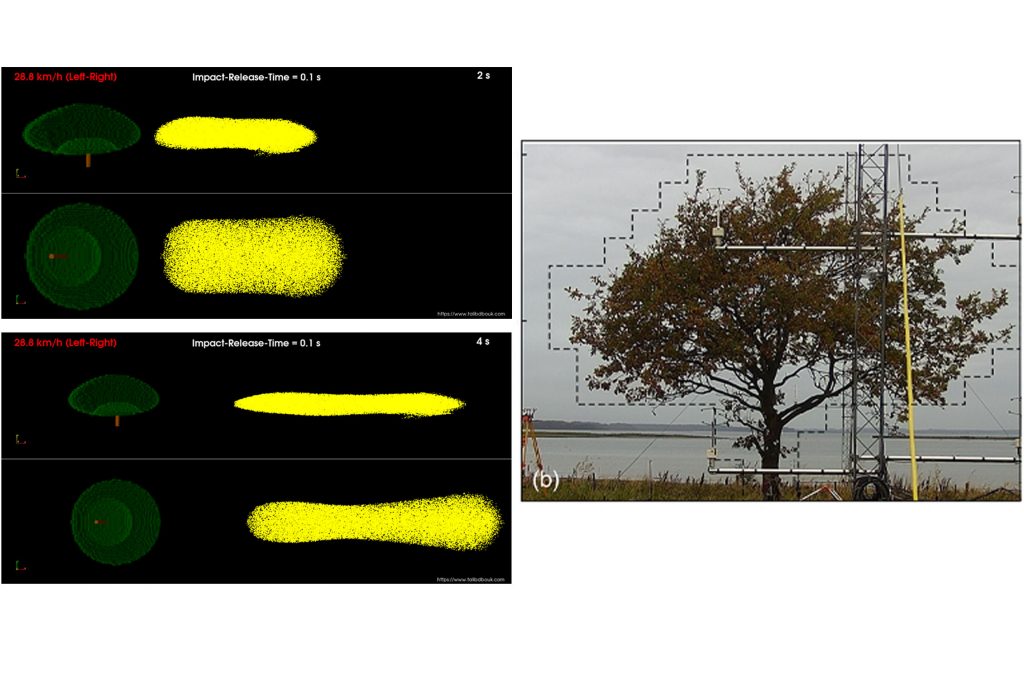
In Physics of Fluids, by AIP Publishing, researchers from Embry‑Riddle Aeronautical University and two French universities, the University of Rouen Normandy and the University of Lille, developed an advanced computational model of outdoor airflow through trees. They used it to study how a tree’s geometry affects the dynamics and dispersion of its airborne pollen grains.
“The wake of a tree is very complex,” said author Talib Dbouk. Within the wake, multiple parameters affect the flow of pollen, including the type of tree, its leaf area density — which may depend on the season — and wind speed and direction.
“These important parameters inform the risk assessment and future mitigation policies aimed at limiting the exposure of people to allergic airborne pollen grains,” Dbouk said.
Using advanced computational fluid dynamics simulation techniques, the researchers modeled the porosity of a tree — what percentage of the volume enclosed by its boundaries is occupied by the tree — and incorporated an algorithm sensitive to small wind forces, taking into account the force required to detach a pollen grain. Most pollen grains are invisible to the naked eye, so these models and simulations allow the researchers to study pollen in a way that can’t be done by experimental measurements on the ground.
They applied their techniques to various known structures, including a previously studied oak tree, and compared the outcomes to real data. Once they confirmed their simulations were reliable, they used the method to study other structures, including a real linden tree (Tilia cordata) located in the Rouen Normandy region of France.
For the linden tree, the researchers found regeneration of turbulence close to the tree, which is a common outcome of wind through canopy-type structures. Comparing the linden and oak trees made it clear that the type and topology of a tree — its shape, leaf area density, or porosity — can lead to distinct pollen dispersion dynamics in the surrounding environment.
They plan to expand and improve their models to better predict larger-scale pollen grain dynamics in urban environments.
“This work provides quantitative insight that can inform urban planning decisions, where public authorities can better orientate the management of green spaces — trees, parks — in urban spaces,” Dbouk said. “This work contributes to reducing the risks associated with airborne allergenic pollen exposure and thus can better guide future public health guidelines and policies in densely crowded areas.”
###
Article Title
Flow and plants: On the dispersion of wind-induced tree pollen
Authors
Talib Dbouk, Nicolas Visez, Prosun Roy, Abdkarim Djama, Emilien Varea, Romain Champion, Alexandre Geffroy, Beatrice Patte-Rouland, and Julien Reveillon
Author Affiliations
University of Rouen Normandy, Université de Lille, Embry-Riddle Aeronautical University