

Larger roofs provide more storage space for snow, increasing accumulation depth; similarly, larger particles will resist wind and pile higher.
From the Journal: Physics of Fluids
WASHINGTON, March 10, 2026 — No two snowflakes may be the same, but models that fail to take these variations into consideration often fall short when calculating the way snow accumulates on roofs.
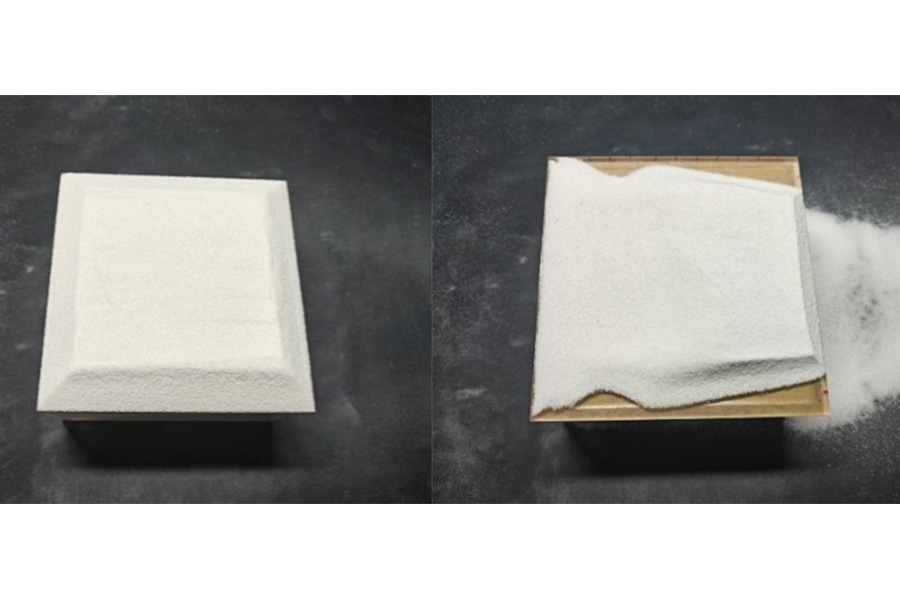
In Physics of Fluids, by AIP Publishing, researchers from Harbin Institute of Technology in China modeled the way snow gathers on a roof based on snowflake size and distribution.
“In cold regions, snow load is a critical factor in structural design,” said author Qingwen Zhang. “However, traditional models often simplify snow as a uniform material with a single particle size, overlooking the natural heterogeneity of snowflake sizes and distributions.”
This simplification can lead to inaccurate predictions of snow accumulation on roofs, potentially compromising the structural safety of buildings. The researchers’ model considers how turbulence can affect recently landed snow and how wind can affect its gathering; they also used wind tunnels with silica “snow” of different sizes to validate their numerical model.
The researchers found that larger snow particles lead to greater snow accumulation on roofs. Higher wind speeds will interrupt accumulation, reducing depth, but the effects of particle size on accumulation are all heightened under higher wind conditions — larger particles will be more resistant to the wind, and smaller ones will accumulate less.
Surprisingly, larger roofs provide more storage space for the snow particles, increasing snow depth, and the researchers observed that this was seen best when the snow particles were about 0.5 millimeters in diameter.
Large-scale engineering simulations representing the full range of particle sizes that are found in a snowstorm are computationally expensive, but the researchers found that using the simple mean diameter of a particle mixture can be an accurate and efficient alternative.
“While the specific distribution patterns will change with roof shape — sloped versus arched, for instance — the underlying principles regarding the influence of particle size, wind velocity, and scale are broadly relevant,” Zhang said.
In the future, the researchers plan to study more complex roof geometries with curves, slopes, and other shapes common in modern architecture. They also hope their findings can inform building codes and guidelines for snow loading.
“Accurately assessing snow loads for structural safety requires considering the natural variation in snowflake sizes, and ignoring this can lead to underestimation of snow accumulation in certain conditions,” Zhang said. “Our research provides both a deeper understanding of the physics involved and a practical tool — the arithmetic mean equivalent diameter — to incorporate this complexity into simulations more efficiently.”
###
Article Title
From transport to deposition: Mapping snow distribution under the particle size effects
Authors
Haiyan Yu, Qingwen Zhang, Jihao Wang, Guolong Zhang, Zheng Li, and Feng Fan
Author Affiliations
Harbin Institute of Technology