

A theory of how microplastic particles accumulate in ocean eddies will inform sampling strategies.
From the Journal: Chaos
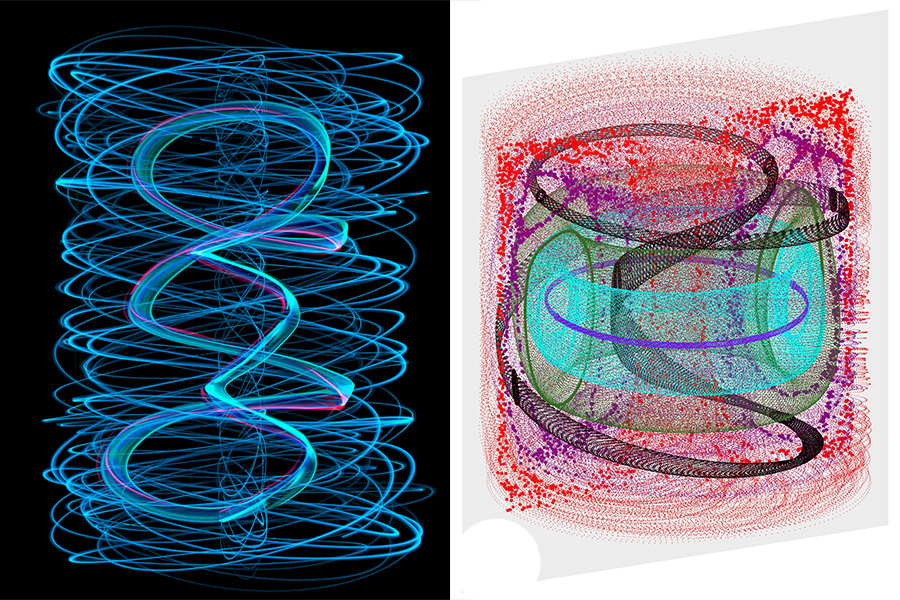
WASHINGTON, Dec. 9, 2025 — The ocean is saturated with microplastics. While we know the location of the great garbage patches, where plastic particles may accumulate below the ocean surface remains unknown. The vastness of the ocean means particle sampling data is sparse, but modeling how particles aggregate in 3D fluid flows can help determine where to look.
In Chaos, by AIP Publishing, researchers from the Woods Hole Oceanographic Institution established a theory for how microplastic particles may accumulate in an idealized eddy, or circular current.
Larry Pratt and Irina Rypina began by modeling how fluid moves in a rotating cylinder, a laboratory setup commonly used to investigate large-scale ocean and atmospheric flows. In it, the body of a cylinder rotates at a constant speed while its lid spins at a different rate. The resulting circulation, in which the water spins up in the middle of the cylinder and spirals down the outer edge, is seen in ocean eddies at a scale of hundreds of kilometers.
When the cylinder lid is tilted, fluid trajectories change. Particle paths are broken up into a tangled flow of chaotic orbits and new donut-shaped circulations that can give rise to attractors of slightly buoyant, small particles — stable behaviors that a system settles into.
“If you just threw a small particle into the water with some arbitrary velocity, viscous drag would rapidly bring its motion close to that of the fluid,” said Pratt. “So, to a first approximation, the microplastic particles are just following the fluid trajectories.”
The complication is that the microplastics have inertia and disrupt the fluid around them, causing them to slowly stray from the fluid’s usual path. Pratt and Rypina exploited the mathematics behind this to develop a theory for how and where particles accumulate. Applying the theory to ocean flows can help determine subsurface areas with high concentrations of microplastics.
They found that particle accumulation occurs in the center of tubelike structures that wind around circular currents. Many such structures may exist, resulting in multiple “attractors” of small particles. Each attractor resembles a twisted, closed loop that particles move along, spiraling upward and downward in the 3D flow.
Pratt and Rypina’s theory explains how, where, and why these flows occur. While their conclusions reflect experimentally and numerically observed flows, they have plans to add more realistic complications.
“The main thing we need to consider is the effects of small-scale turbulence. The theory is valid for spherical particles, but most microplastics in the ocean have very irregular shapes,” said Pratt. “Another challenge for the future is trying to track those, [and] in the immediate future, we’re hoping that the theory will inform sampling strategies and lead to a better understanding of where plastics might be accumulating.”
###
Article Title
A theory for attractors of microplastic particles in the resonant structures of a 3D eddy
Authors
Larry J. Pratt and Irina Rypina
Author Affiliations
Woods Hole Oceanographic Institution