

Brighter colors lead to a warmer ‘tone,’ according to listeners.
From the Journal: The Journal of the Acoustical Society of America
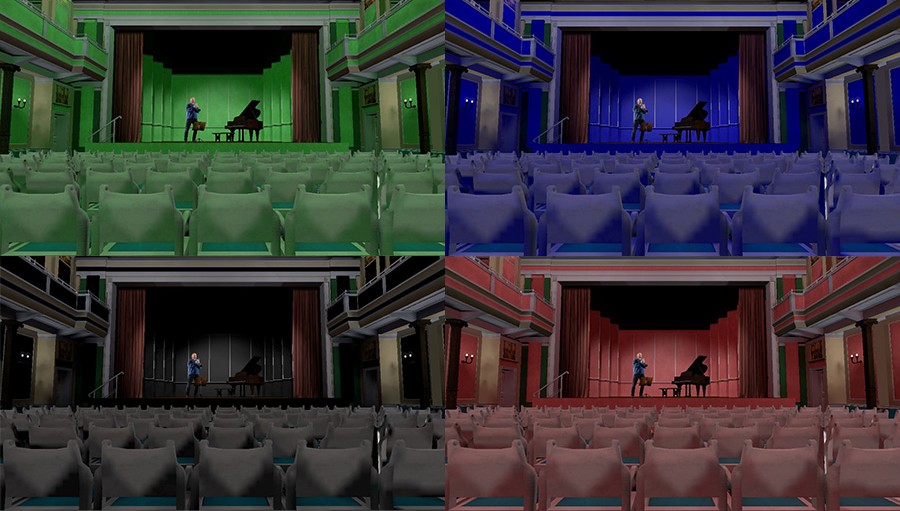
WASHINGTON, Feb. 24, 2026 — Live music can engage more than just one sense, despite it being an auditory medium. Lighting and visual effects can enhance the listening experience, but it is unclear if they can also affect the impression of the sound.
In JASA, published on behalf of the Acoustical Society of America by AIP Publishing, researchers from Germany’s Technical University of Berlin found that the color of a concert hall has an impact on the sound perception of a listener.
“Room acoustics perception is multidimensional,” said author Stefan Weinzierl. “So, we perceive halls as more reverberant or less reverberant; we perceive them as louder or softer, but we also perceive different timbres of a hall — a hall can appear warm, [or] it can appear bright or metallic in sound.”
To test the effects of a hall’s color on sound perception, participants listened to a recorded concert in red, green, and blue venues that varied in hues, brightness, and saturation, creating 12 different-colored environments. Creating multiple venues with chairs, curtains, stages, walls, and decor wasn’t viable, so the researchers used virtual reality platforms to simulate the various concert halls. To make the experience as authentic as possible, participants watched the performances using headphones with binaural technology that could adjust the sound as they moved their heads.
The participants listened to four different music performances — two on violin and two on clarinet — with compositions of varying tempo and time periods and were asked to rate the performances based on liking, strength, reverberance, and timbre.
The researchers discovered a clear correlation between the visual design of the hall and the perceived timbre of the music. Timbre, sometimes understood as the “sound color” of music, was most affected by the visual color. More saturated colors, which appear visually cooler — especially in green and blue — evoked a colder sound color. The participants also tended to have higher “liking” scores of music in darker concert halls. Both effects were enhanced by the participants’ personal music experience.
There was no influence on perceived loudness based on the color of the concert hall, confirming other psychological studies.
“Considering the effort that is done to improve acoustical properties — all the money that is spent for making a concert hall sound well — I think it should not be overlooked that the visual appearance makes its contribution [to] the sound of the hall,” Weinzierl said.
Weinzierl wants to encourage architects and acousticians to consider all elements of space when designing places where music will be enjoyed, down to the fabric of the chairs.
“If you design a concert hall, don’t forget to think about the visual appearance,” Weinzierl said. “It will have an effect on how the sound is perceived.”
###
Article Title
The influence of the color design of auditoriums on room acoustic impression
Authors
Christos Drouzas, Jochen Steffens, and Stefan Weinzierl
Author Affiliations
Technical University of Berlin