

Coating nanostructures on cicada wings in silver can amplify molecule detection signals.
From the Journal: AIP Advances
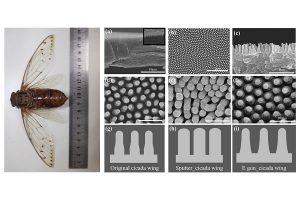
WASHINGTON, Dec. 16, 2025 — Zoom in far enough on an empress cicada wing, and a strange landscape materializes. At the nanoscale, densely packed spires rise from the surface, covering the wing in an endless grove of bowling pins.
These spires, though, are more than just an eerie sight. The highly ordered, evenly spaced spikes can be modified to act as an optical metamaterial, using their tiny geometry to modify interactions between light waves and matter.
In AIP Advances, by AIP Publishing, researchers from China Medical University and National Taiwan University showed that these natural nanostructures can be tuned to amplify signals in molecular detection techniques.
The scientists were interested in using the cicada wing structure to improve surface-enhanced Raman spectroscopy (SERS). Standard Raman spectroscopy illuminates a molecule with a laser beam and collects the unique spectrum of scattered light, which acts as a molecular fingerprint. However, the scattered light signal is often weak, prompting researchers to find ways to enhance it.
SERS takes advantage of enhanced electric fields produced at gaps between metallic nanostructures to amplify Raman scattering signals. While conventional methods for fabricating these nanostructures can carefully calibrate feature size and geometry, they are costly and time-consuming. As such, the low-cost, uniform, and scalable Empress cicada wings appealed to the researchers as a ready-made nanostructure template.
“We wanted to demonstrate that by combining biology’s intrinsic nanoscale design with standard thin film techniques, it is possible to achieve SERS performance comparable to artificially fabricated structures, bridging the gap between nature-inspired design and practical sensing technology,” said author Chung-Hung Hong.
The team coated cicada wing spires in silver nanoparticles using two methods: sputtering deposition and e-gun evaporation. Sputtering turned the nano-spires into cylindrical pillar-like structures. In contrast, e-gun coating made spires more conical.
By analyzing the effect of different coating thicknesses on the performance of the SERS device, the team determined that the cylindrical nanostructures separated by five-nanometer gaps was most promising.
The microscopic gap provided an optimal cranny for strong and consistent electromagnetic hotspots to form in, enhancing SERS performance by a factor of a million compared to non-coated cicada wings.
Looking forward, the team hopes to extend this nature-inspired design to expand beyond the visible, infrared, and ultraviolet lights used in SERS to microwave and millimeter-wave resonator sensors that could detect biomolecules and environmental contaminants.
“In the future, this bio-templating approach could be extended to other natural micro–nanostructures, such as butterfly wings or plant leaves, and integrated with portable sensors for rapid detection of pathogens and pollutants,” said Hong. “We hope this research demonstrates how biological nanostructures can guide engineering design, opening a new path toward sustainable, low-cost, and highly sensitive sensing technologies.”
###
Article Title
Authors
Chung-Hung Hong, Cheng-Wei Kuo, and Hui-Hsin Hsiao
Author Affiliations
China Medical University and National Taiwan University