

Available data isn’t the same as usable. For open data to support verification, reproducibility, and future discovery, others need to find it, understand it, access it appropriately, and know how it can be reused. From planning and documentation to discoverability and clear reuse permissions, these five practical steps will help you prepare research data that others can understand, cite, and build upon.
Why open data isn’t always usable data
Researchers know the frustration of finding an ‘open’ data file only to realize that it has no documentation, context, or clear reuse permissions. You can access the data, but you may not be able to use it. It’s a common challenge. By adopting good data management practices and FAIR principles, you can help make your research easier for others to find, use, and cite.
FAIR principles1 stands for Findable, Accessible, Interoperable, and Reuseable. Building these concepts into your work from the beginning and choose a journal with data and code sharing built in like APL Computational Physics and APL Machine Learning. It’s one way to ensure your work meets the rigor of open science criteria.
Researchers overwhelmingly want openness to work. The 10th anniversary State of Open Data report found 80.9% of researchers surveyed support open data2. Shared data pays off, too: an analysis of 120,000 physics articles found a 4.19% increase in citations for those sharing data openly3. Let’s explore five data sharing best practices to make open science part of how you work, every time.
Step 1: Plan for reuse from the beginning
The best time to think about research data management is before you begin your project. The earlier you think about how to make your data reusable, the easier it is to stay organized. It’s tempting to put it off amid a manuscript’s many moving parts, but a little planning at the start will save a lot of backtracking when you’re ready to start the submission process.
If reusable data practices aren’t yet a habit, work through this list and ask yourself:
- Naming conventions: Will your file and folder names make sense to someone outside your team?
- Documentation: Are you documenting as you go, rather than saving it for later?
- File formats: Have you picked formats that will still be readable years from now?
- Storage: Do you know where your data will live during the project and after?
- Metadata: Have you captured what others will need, such as instrument settings, units, and timestamps?
- Requirements: Have you checked your funder, institutional, journal, or disciplinary requirements?
- Licensing: Have you decided how, and by whom, your data can be reused?
- Ethics and access: Have you thought through any ethical, privacy, consent, contractual, or security considerations?
Planning ahead leaves you with something more useful for your team and the wider scientific community.
Try this: Add a “future reuse” section to your data management plan. Ask: could another researcher use this dataset without needing you to explain it? Would your data set make sense to a researcher five years from now?
Step 2: Make your data understandable
A dataset without context is hard to trust and harder to use. Documentation, most often housed in a README, helps others understand what the data represents, what it contains, how it was produced, and how it’s organized.
A README should walk through:
- Variable definitions: abbreviations, units, codes, exclusions, or missing values need to be understandable to the reader. Spell out abbreviations, even ones that seem obvious.
- Methods: document the instruments and software you used, plus any processing or cleaning decisions that shaped your final dataset. They might hold the key to someone else’s next discovery.
- Data provenance: track where your data came from and how it changed as you worked with it. A clear history is what earns trust in your results.
- Data versioning: if you update your dataset after release, label the changes clearly. Without it, someone could unknowingly build on an outdated version and end up with results that don’t match yours.
- Related outputs: link to the code, protocols, or workflows needed to reproduce your analysis, and connect your dataset back to the published article itself. It’s what makes a standalone file part of the scientific record.
Clear documentation is worth the effort. It supports reproducibility and helps other researchers recognize when your data is exactly what they need.
TIP: If you’re starting from scratch, look for README examples from published datasets in your field to see what good documentation looks like in practice.
Try this: Give your documentation to a colleague who wasn’t involved in the project. Their questions are your missing context. Revise and review again.
Step 3: Use formats and standards that support long-term reuse
The formats you choose, how you name your files, the structure you settle on, all affect whether your data is usable years from now.
What to prioritize:
- Open, widely supported, non-proprietary formats, where practical
- Your discipline’s established standards for data and metadata
- Consistent, meaningful names across files, folders, and variables
- The same structure across related files and datasets
- Clear documentation for any non-standard structure
It’s important to think about interoperability: could your data be combined, compared, or analyzed alongside other datasets in your field? “Interoperable” is one of the four pillars of the FAIR principles.
Try this: Before preparing your final dataset, check what your discipline, institution, funder, journal, or chosen repository recommends specific formats or metadata standards.
Step 4: Make your data findable and citable
Your work deserves to reach its full potential and make a lasting impact. That starts with other researchers being able to find it and connect it back to what you’ve published. Begin by checking your discipline, institution, and funder requirements before depositing your data in a trusted, discipline-appropriate repository like Zenodo, Figshare, or Dryad, etc. Also check your journal’s specific guidance for a data repository suited to your field.
Once deposited, take the time to fill out the repository’s metadata carefully. This is what makes your dataset searchable:
| Common mistake | Fix |
| Title too generic to surface in a search (e.g., “Dataset 1”) | Use a descriptive, specific title |
| Keywords copied straight from the article | Choose terms a data-searcher would use |
| Related publications left unlinked | Link the dataset directly to the article it supports |
Persistent identifiers like DOIs matter here too; they let your dataset be reliably found and properly credited. Include your dataset in your article’s data availability statement and cite it formally in your reference list. AIP Publishing’s data availability statement and downloadable guide provide samples of how to format your citations.
Better discoverability means more opportunities for your research outputs to be found, cited, validated, and used, again and again, moving both your field and your research career forward.
Try this: Search for your own dataset using the terms another researcher in your field might use. Could they find it and tell right away whether it’s relevant to their work?
Step 5: Make access conditions and reuse permissions clear
Openness is a spectrum. Not every dataset can, or should, be completely open. Data tied to privacy, cultural sensitivity, or commercial agreements often needs guardrails, and that’s expected. What matters is that the guardrails are well-defined.
Start with one question: can this data be shared openly?
- Yes: Apply an appropriate, explicit license, so reuse rights aren’t left to guesswork.
- No, or only partially: Explain why. Privacy, consent, ethics, contracts, intellectual property, and security are all legitimate reasons to restrict access, but spell the restriction out plainly, in writing. Where controlled access is the right path, walk through the process: who to contact, what’s required, and how long it typically takes.
It’s worth thinking ahead: could today’s restrictions outlive the reason you put them there? If so, note that too.
Clear access conditions protect participants, communities, and legitimate interests, while still giving other researchers a real way to use your work responsibly, protecting your reputation and strengthening the scientific record.
Try this: Put yourself in another researcher’s shoes. Could they quickly tell how to access your data, what they’re allowed to do with it, and what restrictions apply, without having to ask you directly?
Be part of what comes next
 The most important takeaway is that reusable data does not require perfection, but it does require planning. Preparing clear documentation, sustainable file formats, discoverable records, and transparent reuse conditions all help research remain valuable beyond its original publication. What matters is getting started and building these habits into your workflow over time. Helping to make your data easier for others to understand, verify, cite, and build upon.
Together, these small, deliberate choices make your research easier to understand, validate, reproduce, and expand on. Create outputs engineer to stay useful beyond a single article and give other researchers a stronger foundation for future discovery.
We’re committed to transparency, openness, and trustworthiness in everything we publish, and we want to help you build the same into your own research. AIPP’s Open Science resources cover everything from public access and open data to FAIR principles and beyond, whenever you’re ready to take the next step.
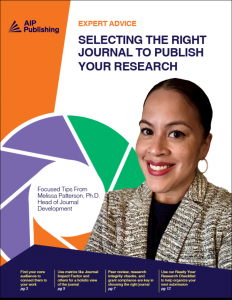 Get Your Free Guide! Download “Expert Advice: Selecting the Right Journal to Publish Your Research” featuring Melissa Patterson, Ph.D., Head of Journal Development, for insider tips to help you with your next submission.
1 https://fairsharing.org/ 2Digital Science, Figshare & Springer Nature. The State of Open Data 2025: A Decade of Progress and Challenges. Figshare (2025). https://doi.org/10.6084/m9.figshare.30823079 3Xu, L. & Chen, H. Does interdisciplinary breadth shape research data sharing and citation impact? Evidence from six research fields. Frontiers in Research Metrics and Analytics 11, 1952277 (2026). https://doi.org/10.3389/frma.2026.1952277