

Many lizards have nanoscopic hairs covering their bodies, which could help them survive in the desert.
From the Journal: Biointerphases
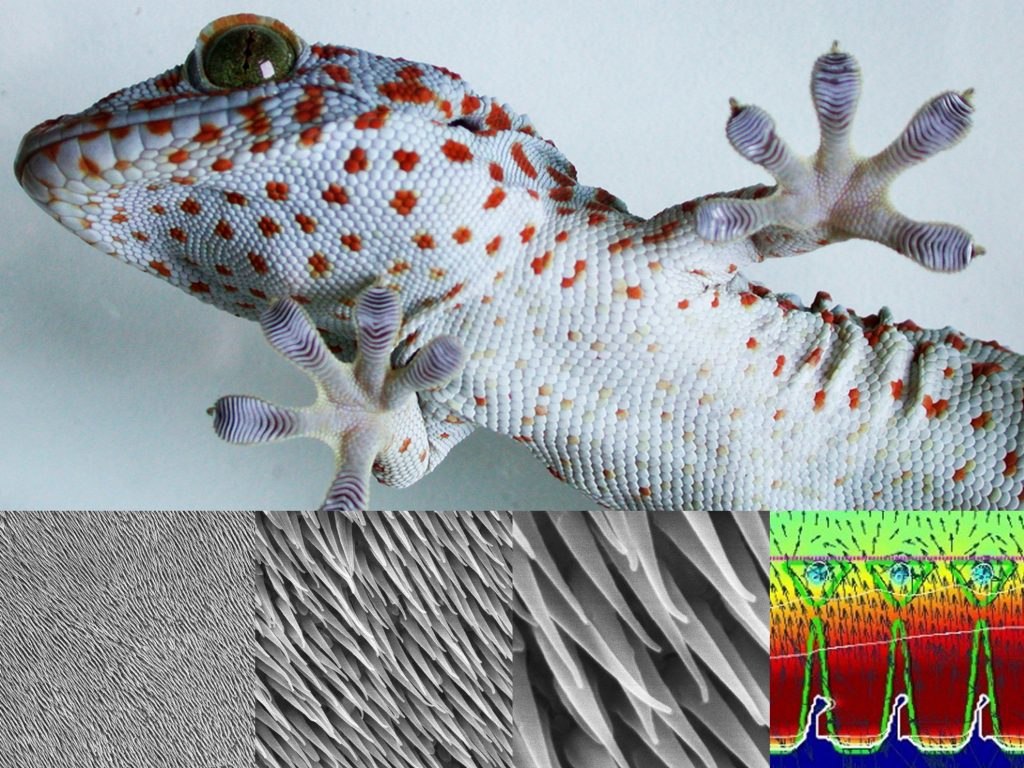
WASHINGTON, Aug. 25, 2026 — In a dry shrubland, a gecko sprints toward shelter. Its greatest danger here is not a predator, although hawks circle overhead and sand cats wait in ambush. Rather, its most pressing concern is dehydration. Its skin is paper thin; water can evaporate from its body into the dry air more quickly than it can replenish it. Fortunately, evolution has given it an adaptation: thin, nanoscopic hairs, called setulae, that cover its body and trap moisture.
While scientists have known about setulae for years, they have never been able to conclusively determine their precise function. However, they show up often in species of geckos and chameleons that live in arid or semiarid environments. In Biointerphases, an AVS journal published by AIP Publishing, researchers from Kiel University sought to explore whether setulae might have a role in preventing water from escaping and keeping the lizards from drying out.
“In biology, nothing appears just for fun. Everything appears due to the combination of mutations and the process of natural selection,” said author Stanislav Gorb. “So what is the original function of these kinds of structures? The idea was to prove whether the microstructure would reduce evaporation.”
The researchers created a simplified computational model of the gecko’s skin, complete with a row of setulae. Using fluid dynamics models, they simulated the flow of air across the skin, evaluating the effects caused by the nanoscale hairs.
There was a possibility that, by increasing surface area, the hairs would increase evaporation and cause the lizards to lose water even faster. But the researchers found that, thanks to their precise arrangement, the setulae trap air between one another, sheltering the skin and retaining water.
“The nanoscale structure generates a boundary layer, which means that the water molecules which leave the surface bounce many times in the confined space, and some of them come back,” said Gorb.
The researchers plan to confirm their results with experiments, using artificial skin or real skin that geckos have previously shed. They also wish to study the impact of the lipids embedded in the structure of the skin that make it more water-repellent.
###
Article Title
Authors
Alexander E. Filippov, Alexander Kovalev, Elena V. Gorb, and Stanislav N. Gorb
Author Affiliations
Kiel University
Biointerphases
Biointerphases, an AVS journal published by AIP Publishing, emphasizes quantitative characterization of biomaterials and biological interfaces. As an interdisciplinary journal, a strong foundation of chemistry, physics, biology, engineering, theory, and/or modelling is incorporated into original articles and reviews. See: https://pubs.aip.org/avs/bip.