

Computational model reveals physical mechanism that keeps so many of us awake at night
From the Journal: Physics of Fluids
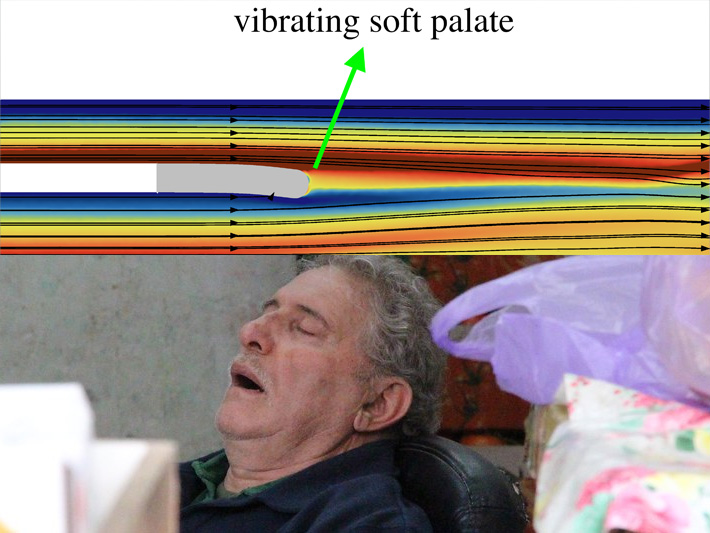
WASHINGTON, August 18, 2026 — Anyone who has had to share a room — or worse, a bed — with a loud snorer knows the effect unchecked snoring can have on sleep, sanity, and emotional stability. An entire industry of products, technologies, and treatments all claim to cure or prevent loud snoring, with varying degrees of success. Most scientific research into snoring, however, is aimed at treating sleep apnea, a serious and potentially life-threatening condition distinct from ordinary snoring.
But snoring not caused by sleep apnea can still be debilitating for the snorer and for the people who have to put up with them. And scientists are still unsure exactly how the sound produced by snoring is generated, which inhibits their ability to prescribe solutions.
In Physics of Fluids, by AIP Publishing, researchers from the KTH Royal Institute of Technology in Sweden developed a 3D model of the upper airway, complete with dynamic airflows, soft tissues, and sound generation. Their goal was to understand how these elements relate to each other.
“Many existing studies simplify breathing or neglect the interaction between airflow, tissue motion, and sound generation,” said author Peng Li. “We hope to better understand how breathing drives snoring and identify the dominant sound generation mechanisms.”
If you touch the roof of your mouth, directly behind your teeth, you’ll feel a rigid, almost bony surface. This is the hard palate, which extends for several inches into the back of your mouth. Further back, however, this hard surface gives way to a smoother, more spongy texture called the soft palate. This soft tissue was the focus of the group’s analysis.
Using their computational model, the researchers re-created the environment of the upper airway, simulating the movement of air through the mouth and watching closely for any sound-producing vibrations. They found that the loudest sounds resulted from unsteady airflow across the soft tissues of the mouth, hinting at possible anti-snoring solutions.
“Our results suggest that reducing soft palate vibration or unsteady aerodynamic loading may help reduce palatal snoring,” said Li. “This could inform evaluation of palatal stiffening procedures or other interventions that modify tissue mechanics or airflow.”
While their model can reveal the mechanics behind snoring, it is still too simplified to offer detailed recommendations for preventing it. For that, the researchers are planning to expand their simulation to incorporate effects from possible treatment options.
“Our next step is to investigate how palatal stiffness affects its vibration and the resulting snoring sound,” said Li. “By systematically varying tissue stiffness, we aim to determine how it changes oscillation amplitude, dominant frequency, airflow patterns, and acoustic source strength. This may clarify how palatal stiffening treatments reduce vibration and identify mechanical conditions that could reduce palatal snoring.”
###
Article Title
Authors
Peng Li, Marco Laudato, and Mihai Mihaescu
Author Affiliations
KTH Royal Institute of Technology