

Wide range of frequencies allows system to auto-adapt to diverse materials
From the Journal: Applied Physics Letters
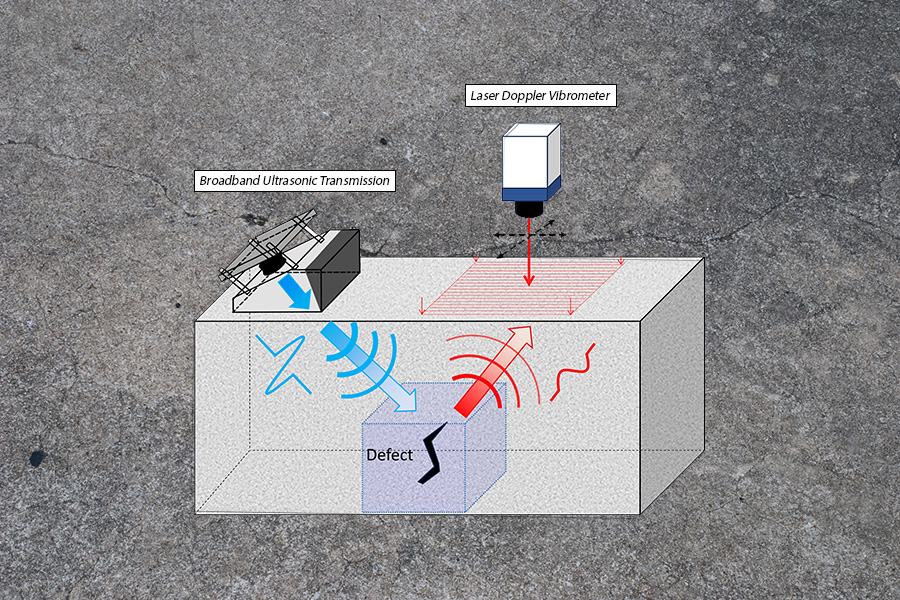
WASHINGTON, Jan. 27, 2026 — Concrete structures like roads and bridges require nondestructive testing methods to identify interior defects without destroying their structure. Most methods send sound waves into the material and capture the waves that echo back to create images of what’s inside and find defects. This process is similar to ultrasounds used to see inside the human body.
But unlike human tissues, concrete contains a diversity of materials, including stone, clay, chalk, slate, iron ore, and sand, that scatter sound waves and make clear imaging difficult to obtain.
In an article in Applied Physics Letters, by AIP Publishing, researchers from Tohoku University, Los Alamos National Laboratory, and Texas A&M University created a high-resolution 3D ultrasonic imaging system for concrete that automatically adapts to different types of structures.
“In our approach, the ultrasonic wave is broadband, using a wide range of ultrasonic frequencies rather than operating around a single, fixed frequency,” author Yoshikazu Ohara said. “The receiver is capable of accepting an even broader range of frequencies. By automatically adapting the frequency to the material, our system improves the contrast between defects and background material in concrete.”
Achieving high-quality imaging of concrete is complicated because waves lose intensity as they travel through concrete due to absorption or scattering. It is hard to know which frequencies of sound waves will survive traveling through the material.
To accommodate the uncertainty, the team used two devices: one to generate a wide range of frequencies to send into the material and another — a vibrometer — to capture the outcoming waves. The system can handle a wide range of frequencies, which means that even if ultrasonic waves are scattered by materials in the concrete, those that do make it through are still detected, regardless of what frequency they are.
“No manual tuning is needed,” Ohara said. “As the concrete filters out certain frequencies, the laser Doppler vibrometer simply captures whatever frequencies remain. Unlike conventional systems, we don’t have to swap transducers or adjust the frequency beforehand. The system adapts automatically.”
Waves exiting the concrete are processed using imaging algorithms the team developed in previous work, which they adapted specifically for broadband ultrasonic data. The result is a high-resolution 3D image of the defect and its location in the concrete.
“For a repair planner or field technician, this provides concrete information: how deep the defect is from the surface, how large it is, and how it extends in three dimensions,” Ohara said. “This makes it possible to plan repairs more efficiently. The method gives a clear 3D map of internal damage that can be directly used for maintenance and repair decisions.”
###
Article Title
Auto-frequency-adaptive 3D ultrasonic phased-array imaging system for highly attenuative materials
Authors
Yuto Fujikawa, Yoshikazu Ohara, and Timothy J. Ulrich
Author Affiliations
Tohoku University, Los Alamos National Laboratory, Texas A&M University