

EEG devices could pick up movement signals and relay them to implants, bypassing damaged spinal cords.
From the Journal: APL Bioengineering
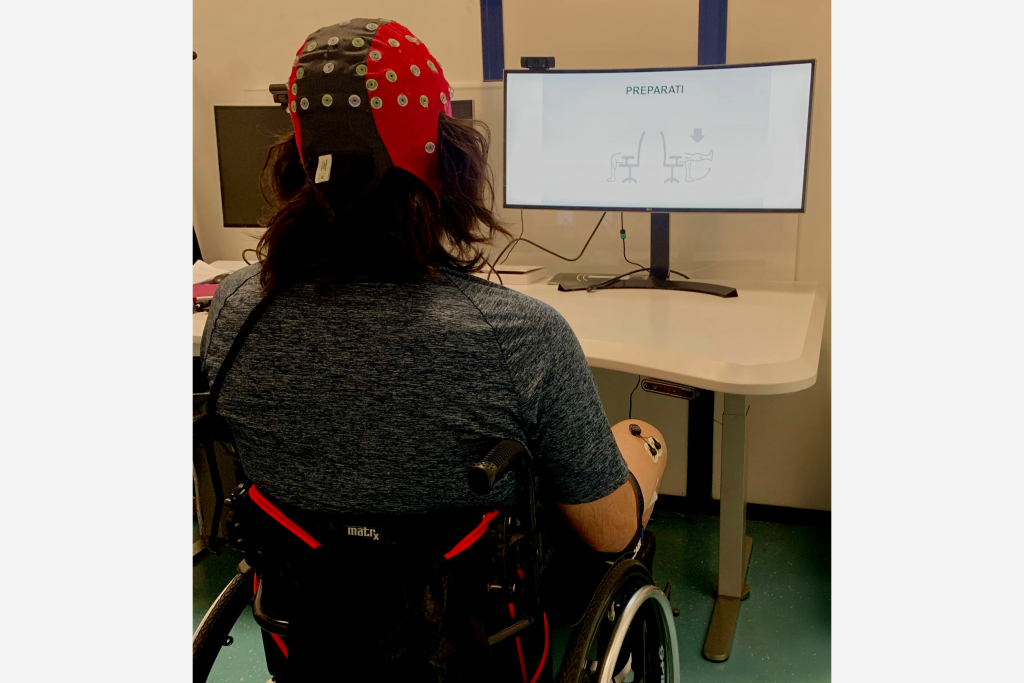
WASHINGTON, Jan. 20, 2026 — People with from spinal cord injuries often lose some or all their limb function. In most patients, the nerves in their limbs work fine, and the neurons in their brain are still operational, but the damage to their spinal cords prevents the two areas from communicating.
In APL Bioengineering, by AIP Publishing, researchers from universities in Italy and Switzerland conducted an initial feasibility study to explore whether electroencephalography (EEG) could be a useful tool for connecting brain signals with limb movements.
When a patient tries to move their paralyzed limb, their brain generates a series of signals corresponding to that movement. If those signals could be read and decoded, they could be relayed to a spinal cord stimulator to control nerve endings in that limb.
Previous research has focused on implantable electrodes to read movement signals. While this approach has met with some success, the authors wanted to study the potential of EEG technology.
EEG devices typically appear as caps full of electrodes that measure brain activity. And while the nest of wires may look intimidating, the authors say this approach is preferable to implanting a device in the brain or spinal column.
“It can cause infections; it’s another surgical procedure,” said author Laura Toni. “We were wondering whether that could be avoided.”
However, decoding attempted limb movements using EEGs is pushing the limits of the technology. Because the electrodes are placed on the surface of a patient’s head, they struggle to pick up signals produced in the deeper regions of the brain. This poses only a small obstacle when applied to arm and hand movements but is more challenging when applied to legs and feet.
“The brain controls lower limb movements mainly in the central area, while upper limb movements are more on the outside,” said Toni. “It’s easier to have a spatial mapping of what you’re trying to decode compared to the lower limbs.”
To help them decode the EEG signals, the authors employed a machine learning algorithm designed to sift through these sorts of limited datasets. In tests, the researchers equipped patients with EEG monitors and asked them to perform a series of simple movements. They collected the resulting data and used their algorithm to classify the range of possible signals.
They found they could detect the difference between attempted movement and no movement but struggled to differentiate between specific signals.
The researchers have ideas on how to increase the effectiveness of their approach in future studies. They want to improve their algorithm to recognize different movement attempts, such as standing, walking, or climbing, and then look for ways to use that data to help trigger those movements in the implants of recovering patients.
###
Article Title
Authors
Laura Toni, Valeria De Seta, Luigi Albano, Daniele Emedoli, Aiden Xu, Vincent Mendez, Filippo Agnesi, Sandro Iannaccone, Pietro Mortini, Silvestro Micera, and Simone Romeni
Author Affiliations
Università Vita Salute San Raffaele, Scuola Superiore Sant’Anna, Ecole Polytechnique Federale de Lausanne, University Hospital Lausanne, and IRCCS Ospedale San Raffaele