

Studies of ancient sea worms reveal a type of material that is not quite metal nor biological.
From the Journal: Biophysics Reviews
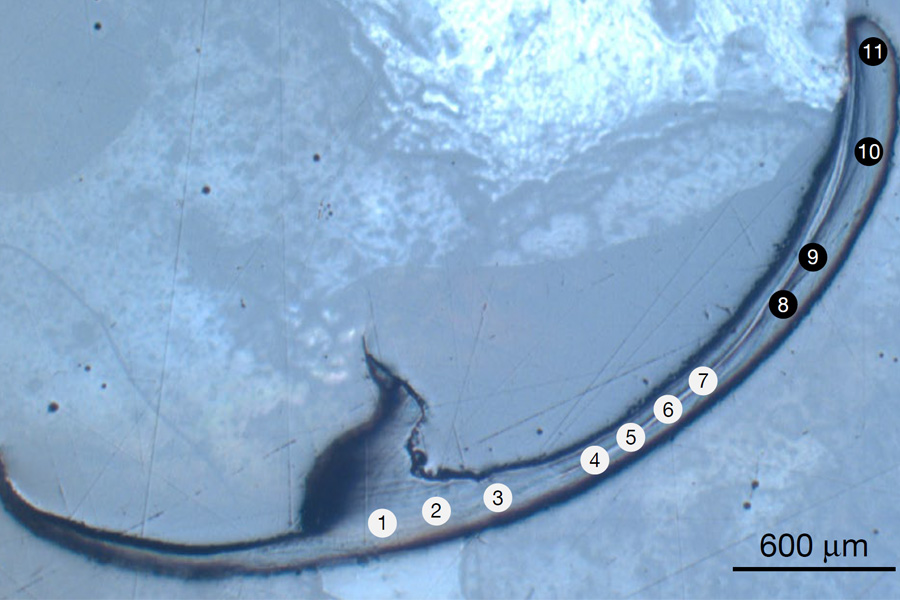
WASHINGTON, July 14, 2026 — When playing the classic game “20 Questions,” one may begin with the common opener: “Animal, vegetable, or mineral?”
For the ancient sea worm Perinereis cultrifera (which is still around to this day), the answer might not be so simple. Along with other predatory bristle worms, Perinereis cultrifera have jaws made from structural proteins and ions, which are used for eating, crushing, or biting. The unique makeup and properties of these jaws led some researchers to coin a new term to describe these types of materials: bio-metals, an emerging field of biophysical studies.
The term “bio-metal” goes beyond identifiers like “metallike biomaterials” or “biomaterials with metallike properties,” which have been used in scientific literature to describe biomaterials with conductivity or strength values similar to metals. Instead, bio-metals can be categorized by three qualities: hardness, strain mechanics, and ion-protein structure.
In Biophysics Reviews, by AIP Publishing, researchers from TU Wien (Vienna University of Technology) and the University of Vienna examined the metallic qualities of the sea worm to further define the new classification.
The researchers began by studying hardness through nanoindentation — in which researchers create microscopic indents in a material — accompanied by chemical analysis and imaging. Confirming earlier studies, they showed that the concentration of metal ions is higher at the tips of the jaw than at the center, likely leading to the increased hardness of the tips.
Then, they probed the jaw with different indentation depths, and surprisingly, discovered a phenomenon seen in metals such as copper or silver, known as the Nix-Gao nanoindentation size effect: Smaller regions of the worm jaw were harder to dent due to the larger spatial change of strain levels. This causes increased interlocking of fractures in the atomic structure and is a hallmark of the size effect.
Despite these similarities, bio-metals are still unique in their mechanical properties.
“Bristle worm jaws also showed size-dependent elasticity — this is a distinguishing feature of bio-metals when compared to standard crystalline metals like copper or silver,” said author Christian Hellmich.
Finally, the researchers theoretically explained these elastic size effects through mathematical modeling of what’s happening at the atomic level. Hellmich said they are only scratching the surface of this research — pun intended.
“We plan to extend the experimental database by investigating additional species to refine the theoretical concept and perform dedicated computations, and — perhaps most interestingly — to explore the link between genetic interventions and the corresponding material design space,” he said. “All this comes with true excitement about the beauty, elegance, and refinement found in and produced by nature.”
###
Article Title
Authors
Luis Zelaya-Lainez, Friedrich S. Schuster, Stefan Manhartseder, Maximilian Landegger, Kyojiro N. Ikeda, Florian Raible, Olaf Lahayne, Stefan Scheiner, and Christian Hellmich
Author Affiliations
TU Wien (Vienna University of Technology) and University of Vienna