

Copper-based coatings are often used to slow bacterial growth on marine surfaces — but bacteria have adapted.
From the Journal: Biointerphases
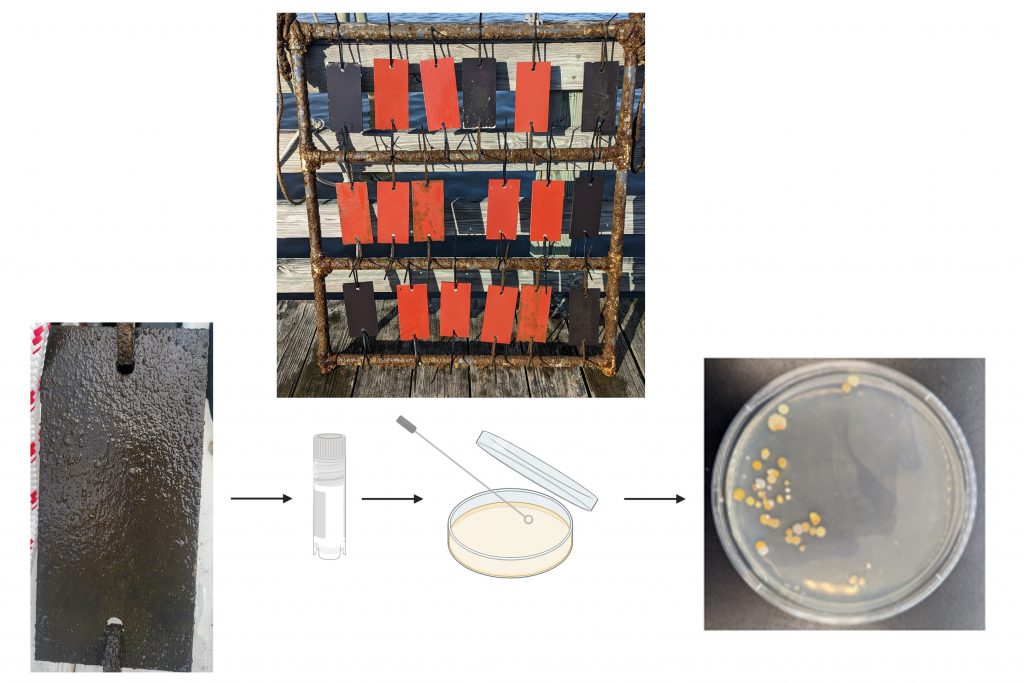
WASHINGTON, Oct. 13, 2026 — Marine bacteria have evolved to bypass the copper-based coatings placed under ships to stop the growth of barnacles, algae, and other marine life. This necessitates new methods for managing biofouling — the unwanted accumulation of marine organisms — on ship hulls.
In Biointerphases, an AVS journal published by AIP Publishing, researchers from the U.S. Naval Research Laboratory and Duke University studied the genetic characteristics of various bacteria species responsible for their survival on copper surfaces, a step toward inhibiting these copper-resistant genes.
“We have observed increasing copper resistance in some of the ports our team frequents over the past decade, particularly in ports with heavy tourist [or] industry shipping activity,” said author Kenan Fears. “We wanted to identify the resistance pathways across a diverse microbial community to provide insight into how members of a complex community could be acting symbiotically to resist toxic environments.”
The researchers placed pieces of PVC panels in the Chesapeake Bay, some coated with a copper-based coating and some left uncoated. After two weeks, they extracted the DNA and sequenced the genomes of the bacterial colonies that grew on the panels to identify the copper-resistant genes and tested each colony’s tolerance against copper-based water treatments.
Surprisingly, the bacteria species had a lot in common regardless of whether they grew near the copper-based coating. The bacteria from the control colonies — the ones that did not initially grow on the copper-coated surfaces — were just as copper-resistant and could thrive at copper concentrations above 70 milligrams per liter.
“To put that in perspective, the U.S. Environmental Protection Agency limit in seawater for a short-term spike in copper is 18 micrograms per liter,” Fears said.
This is a likely marker of evolution and bacteria adapting to their new environments.
“Copper was not always in a water-soluble state; it only became so after oxygen accumulated in Earth’s atmosphere,” Fears said. “However, as environmental copper loading has increased, the bacteria with the best defense mechanisms continued to reproduce.”
The researchers hope to use their findings to target the molecular pathways that help bacteria express copper-resistant genes, weakening their ability to survive in copper-rich environments.
“Our research suggests the smarter path moving forward is to design antifouling coatings that select microbial communities that either help deter macrofouler settlement — like barnacles or tubeworms — or do not impede the release of biocidal compounds,” Fears said. “With increasing regulatory pressure on copper use in antifouling coatings, there is an urgent need for alternatives.”
###
Article Title
Extreme copper tolerance and genomic adaptation in early-stage marine biofilms
Authors
Kailey N. Richard, Sara M. Tuck, Sophie M. Colston, Maryssa A. Beasley, W. Judson Hervey, Kevin Le, Sean Brown, Katherine J. Franz, and Kenan P. Fears
Author Affiliations
U.S. Naval Research Laboratory, Duke University
Biointerphases
Biointerphases, an AVS journal published by AIP Publishing, emphasizes quantitative characterization of biomaterials and biological interfaces. As an interdisciplinary journal, a strong foundation of chemistry, physics, biology, engineering, theory, and/or modelling is incorporated into original articles and reviews. See: https://pubs.aip.org/avs/bip.