

To understand how fungal disease spreads across crops, researchers look at where infection begins — a leaf’s waxy surface.
From the Journal: Biointerphases
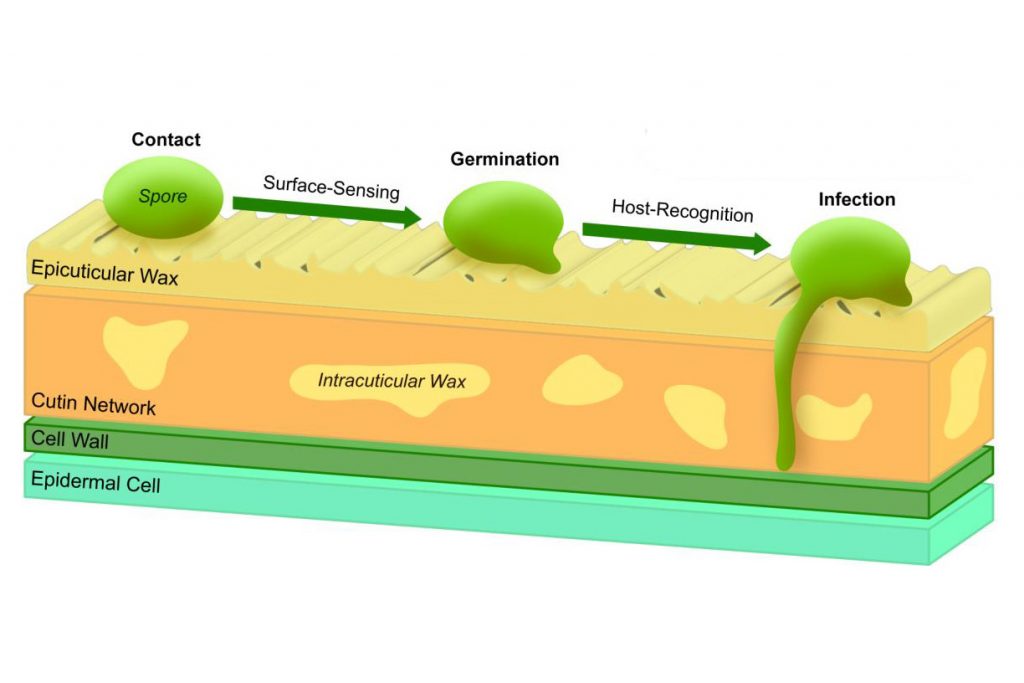
WASHINGTON, Aug. 4, 2026 — Fungal diseases that affect grain crops can be devastating to global agriculture and food security. Fungicides are the most common preventative measure, but as fungal diseases’ prevalence increases, the pathogens become increasingly resilient.
In Biointerphases, an AVS journal published by AIP Publishing, researchers from Adelaide University adopt a biointerfaces approach to this problem. Rather than treating fungal diseases with nontargeted fungicide application, they suggest looking at the location where plant-fungi interactions begin: the leaf’s surface.
“Biomaterials research has developed sophisticated tools for producing highly uniform surface coatings and uses surface analysis to understand complex systems,” said author Bryan Coad. “Applying those techniques to a plant pathology problem allows us to ask new questions and investigate these interactions with a level of control that hasn’t previously been possible.”
Leaves have a natural waxy coating called a cuticle. Though this primarily acts to protect the plant from its environment, research has increasingly shown that it may also emit signals to other organisms — including pathogens like mildew.
By mimicking this coating, scientists can better understand how it functions and how its recognition signals can be turned off.
“The focus now is on identifying the specific surface signals involved in host recognition and exploring how that knowledge can eventually be translated into practical crop protection strategies,” Coad said.
The researchers deposited leaf cuticle wax onto non-biological surfaces to separate the chemical effects of the wax from the geometric effects of the leaves’ structure. They found the two types of powdery mildew they studied were both able to germinate on this wax-coated surface, showing the wax plays role in fungal growth, even without the leaf’s underlying structure.
Though their preliminary results show how the fungal spores interact with cuticle wax, fungal infections rely on a lot of additional parameters and the connections between these parameters, including leaf surface roughness, wettability, and environmental conditions. All these parameters need to be understood to fight fungal pathogens without chemical fungicides.
Creating a full picture of these synergistic and antagonistic interactions will require a multidisciplinary effort that brings together chemists, plant scientists, fungal pathologists, and materials scientists to develop solutions that could not emerge from any one field alone.
“Ultimately, the goal is to prevent fungal pathogens from recognizing their host in the first place,” Coad said. “If we can understand the surface signals that trigger infection, we can begin developing strategies to disrupt or block those signals before disease becomes established.”
###
Article Title
Authors
River J. Pachulicz and Bryan R. Coad
Author Affiliations
Adelaide University
Biointerphases
Biointerphases, an AVS journal published by AIP Publishing, emphasizes quantitative characterization of biomaterials and biological interfaces. As an interdisciplinary journal, a strong foundation of chemistry, physics, biology, engineering, theory, and/or modelling is incorporated into original articles and reviews. See: https://pubs.aip.org/avs/bip.